Conversions and Add-Ons
Add-on equipment can drain the vehicle's 12-volt battery, even if the vehicle is not operating.
The vehicle has an airbag system. Before attempting to add anything electrical to the vehicle, see Servicing the Airbag-Equipped Vehicle 0 80 and
Adding Equipment to the Airbag-Equipped Vehicle 0 80.
For information on wiring auxiliary switches, see www.gmupfitter.com or contact your dealer.
Before installing a snow plow on the vehicle, follow these guidelines:
The plow the vehicle can carry depends on many things, such as:
truck cap.
For example, if the snow plow weighs 318 kg (700 lb), the total weight of all occupants and cargo inside the cab should not exceed 135 kg (300 lb). This means that you may only be able to carry one passenger. Even this may be too
much if there is other equipment already adding to the weight of the vehicle.
To safely carry a snow plow on the vehicle:
Front axle reserve capacity is the difference between the Gross Axle Weight Rating (GAWR) and the front axle weight of the vehicle with full fuel and passengers. This is the amount of weight that can be added to the front axle before reaching the front GAWR.
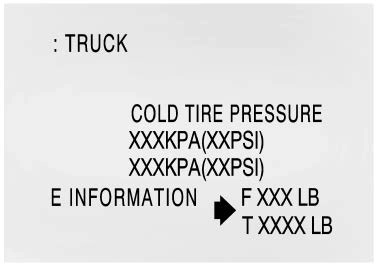
United States
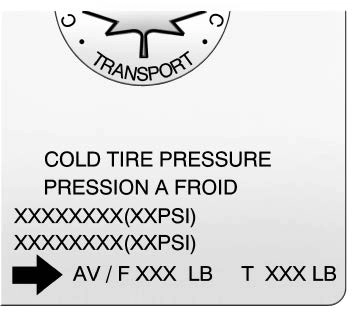
Canada
The front axle reserve capacity for the vehicle is in the lower right corner of the Certification/Tire label.
To calculate the amount of weight any front accessory, such as a snow plow, is adding to the front axle, use this formula:
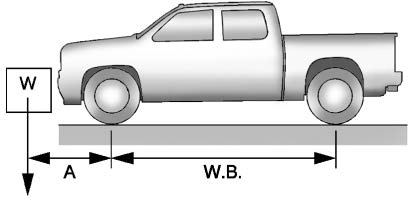
(W x (A + W.B.)) /W.B.= Weight the accessory is adding to the
front axle.
Where:
W = Weight of added accessory A = Distance that the accessory is in front of the front axle
W.B. = Vehicle Wheelbase
For example, adding a 318 kg (700 lb) snow plow actually adds more than 318 kg (700 lb) to the front axle. Using the formula, if the snow plow is 122 cm (4 ft) in front of the front axle and the wheelbase is 305 cm (10 ft), then:
W = 318 kg (700 lb)
A = 122 cm (4 ft)
W.B. = 305 cm (10 ft)
(W x (A + W.B.)/W.B. = (318 x (122 + 305))/305 = 445 kg (980 lb)
This means if the front axle reserve capacity is more than 445 kg (980 lb), the snow plow could be added without exceeding the
front GAWR.
Heavier equipment can be added on the front of the vehicle if less cargo or fewer passengers are carried,
or by positioning cargo toward the rear. This reduces the load on the front. However, the front GAWR, rear GAWR, and Gross Vehicle Weight Rating (GVWR) must never be exceeded.
Total vehicle reserve capacity is the difference between the GVWR and the weight of the truck with full fuel and passengers. It is the amount of weight that can be added to the vehicle before reaching the GVWR.
Reserve capacity numbers are intended as a guide when selecting the amount of equipment or cargo the truck can carry. If unsure of the vehicle's front, rear, or total weight, go to a weigh station and weigh the vehicle. Your dealer can also help with this.
The total vehicle reserve capacity for the vehicle is in the lower right corner of the Certification/Tire label as shown previously.
See your dealer for additional advice and information about using a snow plow on the vehicle. Also, see Vehicle Load Limits 0 197.
We are aware that some vehicle owners might consider having the pickup box removed and a commercial or recreational body installed. Owners should be aware that, as manufactured, there are differences between a chassis cab and a pickup with the box removed which could affect vehicle safety. The components necessary to adapt a pickup to permit its safe use with a specialized body should be installed by the body builder.
Tire Pressure 383
Tire Pressure for High-Speed Operation 385
Tire Pressure Monitor
System 385
Tire Pressure Monitor
Operation 386
Tire Inspection 392
Tire Rotation 392
When It Is Time for New
Tires 394
Buying New Tires 395
Different Size Tires and
Wheels 397
Uniform Tire Quality
Grading 397
Wheel Alignment and Tire
Balance 399
Wheel Replacement 399
Tire Chains 400
If a Tire Goes Flat 401
Tire Changing 402
Full-Size Spare Tire 414
Jump Starting - North
America 415
Towing the Vehicle 419
Recreational Vehicle
Towing 420
Exterior Care 424
Interior Care 430
Floor Mats 433
Download Manual