Before driving
Driving the vehicle
P. 217
1 With the brake pedal depressed, shift the shift lever to D. (P. 225) Release the parking brake. (P. 233)
Gradually release the brake pedal and gently depress the accelera- tor pedal to accelerate the vehicle.
1 With the shift lever in D, depress the brake pedal. If necessary, set the parking brake.
If the vehicle is to be stopped for an extended period of time, shift the shift lever to P or N. (P. 225)
Set the parking brake (P. 233), and shift the shift lever to P (P. 225).
Turn the engine switch to OFF to stop the engine.
Lock the door, making sure that you have the key on your person.
If parking on a hill, block the wheels as needed.
Release the parking brake.
In the following conditions, the engine speed may become high while driving. This is due to automatic up-shifting control or down-shifting implementation to meet driving conditions. It does not indicate sudden acceleration.
To extend the life of the vehicle, observing the following precautions is recom- mended:
Avoid sudden stops.
Do not tow a trailer.
Your vehicle has a drum-in-disc type parking brake system. This type of brake system needs bedding-down of the brake shoes periodically or whenever the parking brake shoes and/or drum are replaced. Have your Toyota dealer per- form the bedding down operation.
Comply with the relevant vehicle registration laws and confirm the availability of the correct fuel. (P. 551)
The emission system operating sounds may continue for a short time after the engine is turned off. This is not a malfunction, and helps to ensure optimal performance of the emission system.
WARNING
Observe the following precautions.
Failure to do so may result in death or serious injury.
Always keep your foot on the brake pedal while stopped with the engine running. This prevents the vehicle from creeping.
However, in the event of an emergency, such as if it becomes impossible to stop the vehicle in the normal way: P. 475
Using the brakes continuously may cause the brakes to overheat and lose effectiveness. (P. 225)
Doing so may result in a loss of vehicle control.
WARNING
Observe the following precautions.
Failure to do so may result in death or serious injury.
Doing so may cause the engine to stall or lead to poor brake and steering performance, resulting in an accident or damage to the vehicle.
Doing so can damage the transmission and may result in a loss of vehicle control.
Doing so can damage the transmission and may result in a loss of vehicle control.
Doing so can damage the transmission and may result in a loss of vehicle control.
WARNING
Have the brake pads checked and replaced by your Toyota dealer as soon as possible.
Rotor damage may result if the pads are not replaced when needed.
It is dangerous to drive the vehicle when the wear limits of the brake pads and/or those of the brake discs are exceeded.
If the vehicle is in any gear other than P or N, the vehicle may move sud- denly and unexpectedly, causing an accident.
Running the engine at high speed while the vehicle is stopped may cause the exhaust system to overheat, which could result in a fire if combustible material is nearby.
Doing so may result in the following:
WARNING
Do not leave the vehicle unattended while the engine is running.
If the vehicle is parked with the shift lever in P but the parking brake is not set, the vehicle may start to move, possibly leading to an accident.
Doing so may cause burns.
Therefore, the vehicle is free to roll even if the automatic transmission is in
P. You or someone else could be seriously injured. You must complete the shifting of the transfer mode. (P. 315)
Always turn the engine off. Otherwise, if you accidentally move the shift lever or depress the accelerator pedal, this could cause an accident or fire due to engine overheating. Additionally, if the vehicle is parked in a poorly ventilated area, exhaust gases may collect and enter the vehicle, leading to death or a serious health hazard.
Braking distance increases when the brakes are wet, and this may cause one side of the vehicle to brake differently than the other side. Also, the parking brake may not securely hold the vehicle.
In this case, braking is still possible, but the brake pedal should be depressed more firmly than usual. Also, the braking distance will increase. Have your brakes fixed immediately.
Each push on the brake pedal uses up the reserve for the power-assisted brakes.
NOTICE
Always set the parking brake, and shift the shift lever to P. Failure to do so may cause the vehicle to move or the vehicle may move suddenly if the accelerator pedal is accidentally depressed.
Doing so may damage the power steering pump.
A flat or damaged tire may cause the following situations. Hold the steering wheel firmly and gradually depress the brake pedal to slow down the vehi- cle.
Information on what to do in case of a flat tire (P. 506)
Do not drive on a road that has flooded after heavy rain, etc. Doing so may cause the following serious damage to the vehicle:
In the event that you drive on a flooded road and the vehicle is flooded, be sure to have your Toyota dealer check the following:
Cargo capacity depends on the total weight of the occupants. (Cargo capacity) = (Total load capacity) - (Total weight of occupants) Steps for Determining Correct Load Limit —
For example, if the “XXX” amount equals 1400 lbs. and there will be five 150 lb passengers in your vehicle, the amount of available cargo and luggage load capacity is 650 lbs. (1400 - 750 (5 x 150) =
650 lbs.)
1 Cargo capacity
Total load capacity (vehicle capacity weight) (P. 538)
When 2 people with the combined weight of A lb. (kg) are riding in your vehicle, which has a total load capacity (vehicle capacity weight) of B lb. (kg), the available amount of cargo and luggage load capacity will be C lb. (kg) as follows:
B*2 lb. (kg) - A*1 lb. (kg) = C*3 lb. (kg)
*1: A = Weight of people
*2: B = Total load capacity
*3: C = Available cargo and luggage load
In this condition, if 3 more passengers with the combined weight of D lb. (kg) get on, the available cargo and luggage load will be reduced E lb. (kg) as follows:
C lb. (kg) - D*4 lb. (kg) = E*5 lb. (kg)
*4: D = Additional weight of people
*5: E = Available cargo and luggage load
As shown in the above example, if the number of occupants increases, the cargo and luggage load will be reduced by an amount that equals the increased weight due to the additional occupants. In other words, if an increase in the number of occupants causes an excess of the total load capacity (combined weight of occupants plus cargo and luggage load), you must reduce the cargo and luggage on your vehicle.
WARNING
The following things may cause a fire if loaded in the luggage compart- ment:
Observe the following precautions.
Failure to do so may prevent the pedals from being depressed properly, may block the driver’s vision, or may result in items hitting the driver or passengers, possibly causing an accident.
Vehicle load limits
Total load capacity means the combined weight of occupants, cargo and luggage.
Seating capacity means the maximum number of occupants whose estimated average weight is 150 lb. (68 kg) per person.
Even if the number of occupants are within the seating capacity, do not exceed the total load capacity.
TWR means the maximum gross trailer weight (trailer weight plus its cargo weight) that your vehicle is able to tow.
Cargo capacity may increase or decrease depending on the weight and the number of occupants.
These details are also described on the tire and loading information label. (P. 442)
Trailer towing
Your vehicle is designed primarily as a passenger-and-load-car- rying vehicle. Towing a trailer can have an adverse impact on handling, performance, braking, durability, and fuel consump- tion. For your safety and the safety of others, you must not over- load your vehicle or trailer. You must also ensure that you are using appropriate towing equipment, that the towing equipment has been installed correctly and used properly, and that you employ the requisite driving habits. (P. 214)
Vehicle-trailer stability and braking performance are affected by trailer stability, brake performance and setting, trailer brakes, the hitch and hitch systems (if equipped).
To tow a trailer safely, use extreme care and drive the vehicle in accordance with your trailer’s characteristics and operating conditions.
Toyota warranties do not apply to damage or malfunction caused by towing a trailer for commercial purposes.
Contact your Toyota dealer for further information about additional requirements such as a towing kit, etc.
The maximum allowable gross combination weight. The gross combination weight is the sum of the total vehicle weight (including the occupants, cargo and any optional equipment installed on the vehicle) and the weight of the trailer being towed (including the cargo in the trailer).
The maximum allowable gross vehicle weight. The gross vehi- cle weight is the total weight of the vehicle. When towing a trailer, it is the sum of the vehi- cle weight (including the occu- pants, cargo and any optional equipment installed on the vehi- cle) and the tongue weight.
The maximum allowable gross axle weight. The gross axle weight is the load placed on each axle (front and rear).

The maximum allowable gross trailer weight. The gross trailer weight is the sum of the trailer weight and the weight of the cargo in the trailer.
TWR is calculated assuming base vehicle with one driver, one front passenger, towing package (if available), hitch and hitch systems (if required).
Additional optional equipment, passengers and cargo in the vehicle will reduce the trailer weight rating so as not to exceed GCWR, GVWR and GAWR.
If the gross trailer weight exceeds 3000 lb. (1360 kg), it is recommended to use a trailer with 2 or more axles.
The load placed on the trailer hitch ball. (P. 205)
The load placed on the 5th wheel mount or the gooseneck ball. (P. 206)
Confirm that the gross trailer weight, gross combination weight, gross vehicle weight, gross axle weight and tongue weight are all within the limits.
|
Model code*1 |
Engine |
Driving system |
Bed type |
GCWR |
TWR |
|
USK51L- CRTSKA |
3UR-FE engine |
2WD |
Standard |
14000 lb. (6350 kg)*2 |
8300 lb. (3760 kg)*2 |
|
16000 lb. (7255 kg)*3 |
10200 lb. (4625 kg)*3 |
||||
|
16000 lb. (7255 kg)*4 |
10100 lb. (4580 kg)*4 |
||||
|
USK51L- CRTLKA |
14000 lb. (6350 kg)*2 |
8200 lb. (3715 kg)*2 |
|||
|
16000 lb. (7255 kg)*3 |
10200 lb. (4625 kg)*3 |
||||
|
16000 lb. (7255 kg)*4 |
10100 lb. (4580 kg)*4 |
||||
|
USK52L- CHTSKA |
Long |
14000 lb. (6350 kg)*2 |
8100 lb. (3670 kg)*2 |
||
|
16000 lb. (7255 kg)*3 |
10100 lb. (4580 kg)*3 |
||||
|
16000 lb. (7255 kg)*4 |
10000 lb. (4535 kg)*4 |
*5: These models meet the tow-vehicle trailering requirement of SAE International per SAE J2807.
|
Model code*1 |
Engine |
Driving system |
Bed type |
GCWR |
TWR |
|
USK56L- CRTSKA |
3UR-FE engine |
4WD |
Standard |
14000 lb. (6350 kg)*2 |
8000 lb. (3625 kg)*2 |
|
16000 lb. (7255 kg)*3 |
9900 lb. (4490 kg)*3 |
||||
|
15820 lb. (7175 kg)*4 |
9600 lb. (4355 kg)*4 |
||||
|
USK56L- CRTLKA |
14000 lb. (6350 kg)*2 |
7900 lb. (3580 kg)*2 |
|||
|
16000 lb. (7255 kg)*3 |
9900 lb. (4490 kg)*3 |
||||
|
15310 lb. (6945 kg)*4 |
9100 lb. (4125 kg)*4 |
||||
|
USK57L- CHTSKA |
Long |
14000 lb. (6350 kg)*2 |
7800 lb. (3535 kg)*2 |
||
|
16000 lb. (7255 kg)*3 |
9800 lb. (4445 kg)*3 |
||||
|
15620 lb. (7085 kg)*4 |
9300 lb. (4215 kg)*4 |
*1: The model code is indicated on the Certification Label. (P. 541)
*2: Vehicles without towing package
*3: Vehicles with towing package
*4: Vehicles with towing package and large fuel tank
CrewMax models
|
Model code*1 |
Engine |
Driving system |
Bed type |
GCWR |
TWR |
|
USK51L- PSTSKA |
3UR-FE engine |
2WD |
Short |
14000 lb. (6350 kg)*2 |
8100 lb. (3670 kg)*2 |
|
16000 lb. (7255 kg)*3 |
10100 lb. (4580 kg)*3 |
||||
|
15890 lb. (7205 kg)*4 |
9900 lb. (4490 kg)*4 |
||||
|
USK51L- PSTLKA |
14000 lb. (6350 kg)*2 |
8000 lb. (3625 kg)*2 |
|||
|
16000 lb. (7255 kg)*3 |
10000 lb. (4535 kg)*3 |
||||
|
15530 lb. (7045 kg)*4 |
9400 lb. (4260 kg)*4 |
||||
|
USK51L- PSTZKA |
14000 lb. (6350 kg)*2 |
8000 lb. (3625 kg)*2 |
|||
|
16000 lb. (7255 kg)*3 |
10000 lb. (4535 kg)*3 |
||||
|
15520 lb. (7040 kg)*4 |
9400 lb. (4260 kg)*4 |
||||
|
USK56L- PSTSKA |
4WD |
14000 lb. (6350 kg)*2 |
7800 lb. (3535 kg)*2 |
||
|
16000 lb. (7255 kg)*3 |
9800 lb. (4445 kg)*3 |
||||
|
15510 lb. (7035 kg)*4 |
9200 lb. (4170 kg)*4 |
||||
|
USK56L- PSTLKA |
14000 lb. (6350 kg)*2 |
7800 lb. (3535 kg)*2 |
|||
|
16000 lb. (7255 kg)*3 |
9700 lb. (4400 kg)*3 |
||||
|
15140 lb. (6865 kg)*4 |
8800 lb. (3990 kg)*4 |
|
Model code*1 |
Engine |
Driving system |
Bed type |
GCWR |
TWR |
|
USK56L- PSTZKA |
3UR-FE engine |
4WD |
Short |
14000 lb. (6350 kg)*2 |
7800 lb. (3535 kg)*2 |
|
16000 lb. (7255 kg)*3 |
9800 lb. (4445 kg)*3 |
||||
|
15160 lb. (6875 kg)*4 |
8800 lb. (3990 kg)*4 |
*1: The model code is indicated on the Certification Label. (P. 541)
*2: Vehicles without towing package
*3: Vehicles with towing package
*4: Vehicles with towing package and large fuel tank
1000 lb. (453 kg)
*5: These models meet the tow-vehicle trailering requirement of SAE International per SAE J2807.
The gross trailer weight should be distributed so that the tongue weight is 9% to 11%. (Tongue Weight/Gross trailer weight x 100
= 9% to 11%)
Gross trailer weight
Tongue Weight 

If using a weight distributing hitch when towing, return the front axle to the same weight as before the trailer connection.
If front axle weight cannot be measured directly, measure the front fender height above the front axle before connection. Adjust weight distributing hitch torque until front fender is returned to the same height as before connection.
Do not reduce front fender height below original measurement.
The gross trailer weight, gross axle weight and tongue weight can be measured with platform scales found at a highway weigh- ing station, building supply company, trucking company, junk yard, etc.
The gross trailer weight should be distributed so that the kingpin weight is 14% to 16%. (Kingpin weight/Gross trailer weight x 100
= 14% to 16%)
Gross trailer weight
Kingpin weight 

The gross trailer weight and kingpin weight can be measured with platform scales found at a highway weighing station, build- ing supply company, trucking company, junk yard, etc.
CrewMax models: Current fifth wheel trailer designs are not com- patible with short bed.
Trailer hitch assemblies have different weight capacities. Toyota rec- ommends the use of Toyota hitch/bracket for your vehicle. For details, contact your Toyota dealer.
The rear bumper of your vehicle is
equipped with a hole to install a trailer ball. If you have any ques- tions, contact your Toyota dealer.
The gross trailer weight (trailer weight plus cargo weight) when towing with the bumper must never exceed the TWR (P. 201) or 5000 lb. (2268 kg) whichever is lower.
Trailer ball load rating
Matches or exceeds the gross trailer weight rating of the trailer.
Matches the size of the trailer cou- pler. Most couplers are stamped with the required trailer ball size.
|
Trailer class |
IV |
II and III |
I |
|
Typical trailer ball size |
2 5/16 in. |
2 in. |
1 7/8 in. |
Protrudes beyond the bottom of the lock washer and nut by at least 2 threads.
Matches the ball mount hole diameter size.
Use the wire harness stored in the rear end of the vehicle.
The tow lighting system is designed for 64 watts/5 amps of electrical current per side (right and left) for the trailer brake/turn light functions.
Please contact your Toyota dealer with any questions or concerns.
Vehicles without towing pack- age
Vehicles with towing package
Your vehicle is equipped with a service connector for supplemental trailer brake controllers.
Please consult your dealer on how to access the service connector.
Increasing vehicle speed can destabilize the trailer.
Transmission shift range position must be in 4 in the S mode.
(P. 529)
Apply the brakes and keep them applied.
Have someone place wheel blocks under both the vehicle’s and trailer’s wheels.
When the wheel blocks are in place, release the brakes slowly until the blocks absorb the load.
Apply the parking brake firmly. Shift into P and turn off the engine.
With the transmission in P, start the engine. Be sure to keep the brake pedal pressed.
Shift into D or R (if reversing).
Release the parking brake and brake pedal, and slowly pull or back away from the wheel blocks. Stop and apply the brakes.
Have someone retrieve the blocks.
P. 327
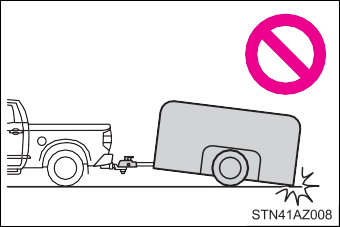 No matter which class of tow hitch applies, for a more safe trailer hookup, the trailer ball setup must be the proper height for the coupler on the trailer.
Coupler Trailer ball
Check that the following conditions are met:
Do not drive if the trailer is not level, and check for improper tongue weight, overloading, worn suspension, or other possible causes.
If your vehicle is new or equipped with any new power train components (such as an engine, transmission, differential or wheel bearing), Toyota rec- ommends that you do not tow a trailer until the vehicle has been driven for over 500 miles (800 km).
After the vehicle has been driven for over 500 miles (800 km), you can start towing. However, for the next 500 miles (800 km), drive the vehicle at a speed of less than 50 mph (80 km/h) when towing a trailer, and avoid full throttle acceleration.
One or more factors (crosswinds, passing vehicles, rough roads, etc.) can adversely affect handling of your vehicle and trailer, causing instability.
Do not try to control trailer swaying by turning the steering wheel.
Do not increase speed. Do not apply vehicle brakes.
If you make no extreme correction with the steering or brakes, your vehicle and trailer should stabilize. (if enabled, Trailer Sway Control can also help to stabilize the vehicle and trailer.)
Make sure the load has not shifted.
Make sure the tongue weight is appropriate, if possible.
Make sure the vehicle is not overloaded after occupants get in.
If you cannot find any problems, the speed at which trailer swaying occurred is beyond the limit of your particular vehicle-trailer combination.
Drive at a lower speed to prevent instability. Remember that swaying of the towing vehicle-trailer increases as speed increases.
WARNING
To tow a trailer safely, use extreme care and drive the vehicle in accordance with the trailer’s characteristics and operating conditions. Failure to do so could cause an accident resulting in death or serious injury. Vehicle stability and braking performance are affected by trailer stability, brake setting and performance, and the hitch. Your vehicle will handle differently when towing a trailer.
WARNING
Trailer hitch assemblies have different weight capacities established by the hitch manufacturer. Even though the vehicle may be physically capable of towing a higher weight, the operator must determine the maximum weight rating of the particular hitch assembly and never exceed the maximum weight rating specified for the trailer-hitch. Exceeding the maximum weight rating set by the trailer-hitch manufacturer can cause an accident resulting in death or serious personal injuries.
Toyota recommends trailers with brakes that conform to any applicable fed- eral and state/provincial regulations.
NOTICE
Use only the position recommended by your Toyota dealer. Do not install the trailer hitch on the bumper; this may cause body damage.
Do not directly splice trailer lights. Directly splicing trailer lights may damage your vehicle’s electrical system and cause a malfunction.
Be careful not to hit the cabin or bed with the trailer while making a sharp turn.
Turn the engine switch to the “START” position to start the engine.
The steering wheel is locked and the key can be removed. (The key can be removed only when the shift lever is in P.)
Some electrical components such as the audio system can be used.
All electrical components can be used.
For starting the engine.
1 Shift the shift lever to P.
2 Push in the key and turn it to OFF.
The engine immobilizer system may not have been deactivated. (P. 85) Contact your Toyota dealer.
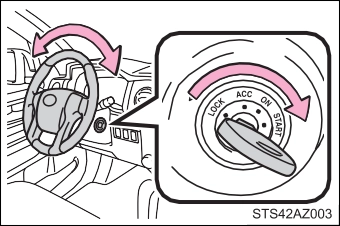 When starting the engine, the engine switch may seem stuck in the OFF. To free it, turn the key while turning the steer- ing wheel slightly left and right.
A buzzer sounds if the driver’s door is opened while the engine switch is in ACC or OFF to remind you to remove the key.
and a message will be dis-
played on the multi-information dis- play.
If it is not displayed, the engine cannot be started.
When operating the engine switch, one short, firm press is enough. It is not necessary to press and hold the switch.
The engine will crank until it starts or for up to 30 seconds, whichever is less.
Continue depressing the brake pedal until the engine is completely started.
The engine can be started from any engine switch mode.
Set the parking brake (P. 233), and shift the shift lever to P. Press the engine switch.
Release the brake pedal and check that the display on the instru- ment cluster is off.
Modes can be changed by pressing the engine switch with brake pedal released. (The mode changes each time the switch is pressed.)
OFF*
The emergency flashers can be used.
Some electrical components such as the audio system can be used.
“ACCESSORY” will be displayed on the multi-information display.
All electrical components can be used.
“IGNITION ON” will be displayed on the multi-information display.
*: If the shift lever is in a position other than P when turning off the engine, the engine switch will be turned to ACC, not to off.
Download Manual