Driving procedures
Engine (ignition) switch
Turn the engine switch to the “START” position to start the engine.
The steering wheel is locked and the key can be removed. (The key can be removed only when the shift lever is in P.)
Some electrical components such as the audio system can be used.
All electrical components can be used.
For starting the engine.
1 Shift the shift lever to P.
2 Push in the key and turn it to the “LOCK” position.
The engine immobilizer system may not have been deactivated. (P. 76) Contact your Toyota dealer.
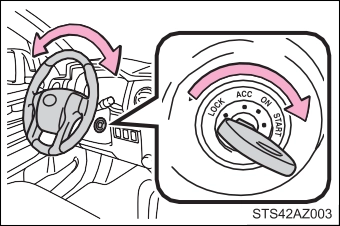 When starting the engine, the engine switch may seem stuck in the “LOCK” position. To free it, turn the key while turn- ing the steering wheel slightly left and right.
A buzzer sounds if the driver’s door is opened while the engine switch is in the “ACC” or “LOCK” position to remind you to remove the key.
 While the engine switch is in the “ON” position, move the shift lever with the brake pedal depressed.
When shifting the shift lever between P and D, make sure that the vehi- cle is completely stopped.
|
|
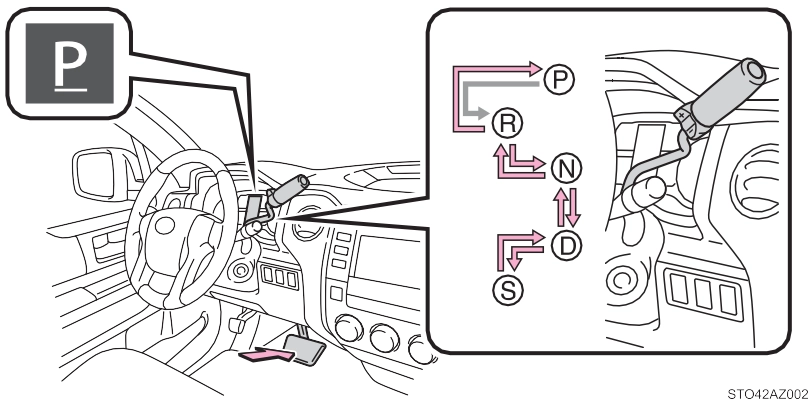
 While the engine switch is in the “ON” position, move the shift lever with the brake pedal depressed.
When shifting the shift lever between P and D, make sure that the vehi- cle is completely stopped.
|
Shift position |
Function |
|
P |
Parking the vehicle/starting the engine |
|
R |
Reversing |
|
N |
Neutral (Condition in which the power is not transmitted) |
|
D |
Normal driving*1 |
|
S |
S mode driving*2 (P. 198) |
*1: To improve fuel efficiency and reduce noises, set the shift lever in the D position for normal driving.
*2: Selecting shift ranges using S mode restricts the upper limit of the possible gear ranges, controls engine braking forces, and prevents unnecessary upshifting.
Floor shift type Column shift type
Upshifting Downshifting
The selected shift range, from 1 to 6, will be displayed in the meter.
The initial shift range in S mode is set automatically to 5 or 4 accord- ing to vehicle speed. However, the initial shift range may be set to 3 or 2 if the AI-SHIFT (P. 200) has operated while the shift lever was in the D position.
Use TOW/HAUL mode when pulling a trailer or hauling a heavy load. Press the TOW/HAUL switch. The indicator will come on.
Press the switch once more to cancel the mode.
AI-SHIFT automatically selects the suitable gear according to the driver per- formance and driving conditions.
AI-SHIFT automatically operates when the shift lever is in the D position. (Shifting the shift lever to the S position cancels the function.)
Even when performing the following actions with the intent of enabling engine braking, engine braking will not activate while driving in S mode and down- shifting to 5 or 4 because cruise control will not be canceled. (P. 251, 265)
The shift lock system is a system to prevent accidental operation of the shift lever in starting.
The shift lever can be shifted from P only when the engine switch is in the “ON” position and the brake pedal is being depressed.
First, check whether the brake pedal is being depressed.
If the shift lever cannot be shifted with your foot on the brake pedal, there may be a problem with the shift lock system. Have the vehicle inspected by your Toyota dealer immediately.
The following steps may be used as an emergency measure to ensure that the shift lever can be shifted.
Releasing the shift lock:
1 Set the parking brake.
2 Turn the engine switch to the “LOCK” position.
3 Depress the brake pedal.
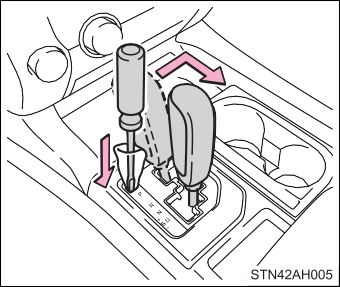
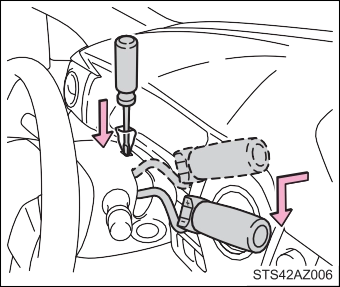
4 Pry the cover up with a flathead screwdriver or equivalent tool.
To prevent damage to the cover, cover the tip of the screwdriver with a rag.
Floor shift type Column-shift type
5 Press the shift lock override button.
The shift lever can be shifted while the button is pressed.
Floor shift type Column-shift type
This may indicate a malfunction in the automatic transmission system. Have the vehicle inspected by your Toyota dealer, immediately.
(In this situation, the transmission will operate in the same manner as when the shift lever is in D.)
To help ensure safety and driving performance, downshifting operation may sometimes be restricted. In some circumstances, downshifting may not be possible even when the shift lever is operated. (A buzzer will sound twice.)
If the tires spin continually when the vehicle becomes stuck in mud, dirt or snow, the automatic transmission temperature may become too high and cause damage.
To avoid the damaging the automatic transmission, the system may tempo- rarily lock the gear in 1st.
If the automatic transmission temperature falls, the gear locking is canceled and returns the automatic transmission to the normal operation.
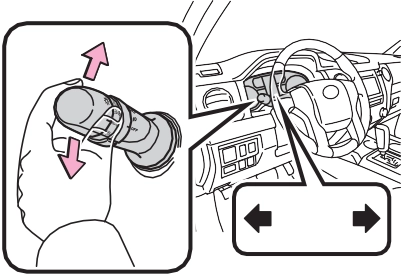 Lane change to the right (move the lever partway and release it)
The right hand signals will flash 3 times.
The left hand signals will flash 3 times.
The engine switch is in the “ON” position.
Check that a light bulb in the front or rear turn signal lights has not burned out.
(Depressing the pedal again releases the parking brake.)
P. 160
P. 312
Download Manual