Information before driving your Toyota
Break−in period
Drive gently and avoid high speeds.
Your vehicle does not need an elaboratebreak−in. But following a few simple tipsfor the first 1000 km (600 miles) can addto the future economy and long life ofyour vehicle:
- Avoid full−throttle acceleration whenstarting and driving.
- Avoid racing the hybrid engine.
- Try to avoid hard stops during the first300 km (200 miles).
Fuel
FUEL TYPE
Your vehicle must use only unleadedgasoline.
To help prevent gas station mixups, yourToyota has a smaller fuel tank opening.The special nozzle on pumps with unleadedfuel will fit it, but the larger standardnozzle on pumps with leaded gas willnot.
At a minimum, the gasoline you useshould meet the specifications of ASTMD4814 in the U.S.A. and CGSB 3.5−M93in Canada.
NOTICE
Do not use leaded gasoline. Use ofleaded gasoline will cause the three−way catalytic converter to lose its effectivenessand the emission controlsystem to function improperly. Also,this can increase maintenance costs.
OCTANE RATING
Select unleaded gasoline with an OctaneRating of 87 (Research OctaneNumber 91) or higher.
Use of unleaded fuel with an octane ratinglower than 87 may result in engine knocking.Persistent knocking can lead to enginedamage.
If your engine knocks...
If you detect heavy knocking even whenusing the recommended fuel, or if youhear steady knocking while holding asteady speed on level roads, consult yourToyota dealer.
However, occasionally, you may noticelight knocking for a short time while acceleratingor driving up hills. This is normaland there is no need for concern.
GASOLINE CONTAINING DETERGENTADDITIVES
Toyota recommends the use of gasolinethat contains detergent additives toavoid build−up of engine deposits.
However, all gasoline sold in the U.S.contains detergent additives to keep cleanand/or clean intake systems.
QUALITY GASOLINE
Automotive manufacturers in the U.S.,Europe and Japan have developed aspecification for quality fuel namedWorld−Wide Fuel Charter (WWFC) thatis expected to be applied world wide.The WWFC consists of four categoriesthat depend on required emission levels.In the U.S., category 4 has beenadopted. The WWFC improves air qualityby providing for better emissions invehicle fleets, and customer satisfactionthrough better vehicle performance.
CLEANER BURNING GASOLINE
Cleaner burning gasoline, including reformulatedgasoline that contains oxygenatessuch as ethanol or MTBE isavailable in many areas.Toyota recommends the use of cleanerburning gasoline and appropriately blendedreformulated gasoline. These types of gasolineprovide excellent vehicle performance,reduce vehicle emissions, and improveair quality.
OXYGENATES IN GASOLINE
Toyota allows the use of oxygenateblended gasoline where the oxygenatecontent is up to 10% ethanol or 15%MTBE. If you use gasohol in yourToyota, be sure that it has an octanerating no lower than 87.
Toyota does not recommend the use ofgasoline containing methanol.
GASOLINE CONTAINING MMT
Some gasoline contain an octane enhancingadditive called MMT (MethylcyclopentadienylManganese Tricarbonyl).
Toyota does not recommend the use ofgasoline that contains MMT. If fuel containingMMT is used, your emission controlsystem may be adversely affected.The Malfunction Indicator Lamp on the instrumentcluster may come on. If this happens,contact your Toyota dealer for service.
GASOLINE QUALITY
In a very few cases, you may experiencedriveability problems caused by the particulargasoline that you are using. If youcontinue to have unacceptable driveability,try changing gasoline brands. If this doesnot rectify your problem, then consult yourToyota dealer.
NOTICE
- Do not use gasohol other thanstated above. It will cause fuel systemdamage or vehicle performanceproblems.
- If drivability problems are encountered(poor hot starting, vaporizing,engine knock, etc.), discontinue itsuse.
- Take care not to spill gasohol duringrefueling. Gasohol may causepaint damage.
FUEL TANK CAPACITY
45 L (11.9 gal., 9.9 lmp.gal.)
The given fuel tank capacity is measuredon EPA/CARB ORVR testing conditionwhich is approved for nominal capacitymeasurement condition.
The fuel tank capacity is decreased at lowambient temperature. (decreased by about5 L (1.3 gal., 1.1 lmp.gal.) at −10 C(14 F).)
Fuel pump shut−off system
The fuel pump shut−off system stops supplyingfuel to the engine to minimize therisk of fuel leakage when the engine stallsor an airbag inflates upon collision. Torestart the hybrid system after the fuelpump shut−off system activates, press the“POWER” switch to the “OFF” mode andstart it.
CAUTION
Inspect the ground under the vehiclebefore restarting the hybrid system. Ifyou find that fuel has leaked onto theground, the fuel system has beendamaged and is in need of repair. Inthis case, do not restart the hybridsystem.
Operation in foreign countries
If you plan to drive your Toyota inanother country...
First, comply with the vehicle registrationlaws.
Second, confirm the availability of the correctfuel (unleaded and minimum octanenumber).
Three−way catalytic converters

The three−way catalytic converters areemission control devices installed inthe exhaust system.
Its purpose is to reduce pollutants in theexhaust gas.
CAUTION
Keep people and combustible materialsaway from the exhaust pipewhile the engine is running. Theexhaust gas is very hot.
Do not drive, idle or park your vehicleover anything that might burneasily such as grass, leaves, paperor rags.
NOTICE
A large amount of unburned gasesflowing into the three−way catalyticconverter may cause it to overheatand create a fire hazard. To preventthis and other damage, observe thefollowing precautions:
- Use only unleaded gasoline.
- Do not drive with an extremely lowfuel level; running out of fuel couldcause the engine to misfire, creatingan excessive load on the three−way catalytic converter.
- Do not turn off the ignition whilethe vehicle is moving.
- Keep your engine in good runningorder. Malfunctions in the engineelectrical system, electronic ignitionsystem/distributor ignition systemor fuel system could cause an extremelyhigh temperature.
- If the engine becomes difficult tostart or stalls frequently, take yourvehicle in for a check−up as soonas possible. Remember, your Toyotadealer knows your vehicle and itsthree−way catalytic converter systembest.
- To ensure that the three−way catalyticconverter and the entire emissioncontrol system operate properly,your vehicle must receive theperiodic inspections required by theToyota Maintenance Schedule. Forscheduled maintenance information,refer to the “Scheduled MaintenanceGuide” or “Owner’s Manual Supplement”.
Engine exhaust cautions
CAUTION
- Avoid inhaling the engine exhaust.It contains carbon monoxide, whichis a colorless and odorless gas. Itcan cause unconsciousness or evendeath.
- Make sure the exhaust system hasno holes or loose connections. Thesystem should be checked fromtime to time. If you hit something,or notice a change in the sound ofthe exhaust, have the systemchecked immediately.
- Do not run the hybrid system in agarage or enclosed area except forthe time needed to drive the vehiclein or out. The exhaust gases cannotescape, making this a particularlydangerous situation.
- Do not remain for a long time in aparked vehicle with the hybrid systemrunning. If it is unavoidable,however, do so only in an unconfinedarea and adjust the heating orcooling system to force outside airinto the vehicle.
- Keep the back door closed whiledriving. An open or unsealed backdoor may cause exhaust gases tobe drawn into the vehicle.
- To allow proper operation of yourvehicle’s ventilation system, keepthe inlet grilles in front of the windshieldclear of snow, leaves, or otherobstructions.
- If you smell exhaust fumes in thevehicle, open the windows andclose the back door to ensureplenty of fresh air enters the vehicle.If you can smell exhaustfumes even though there are noother vehicles in the surroundingarea, have your vehicle checked byyour Toyota dealer. Continued inhalationof exhaust fumes can leadto death by gas poisoning.
Facts about engine oil consumption
FUNCTIONS OF ENGINE OIL
Engine oil has the primary functions oflubricating and cooling the inside of theengine, and plays a major role in maintainingthe engine in proper working order.
ENGINE OIL CONSUMPTION
It is normal that an engine should consumesome engine oil during normalengine operation. The causes of oilconsumption in a normal engine are asfollows.
Oil is used to lubricate pistons, pistonrings and cylinders. A thin film of oilis left on the cylinder wall when apiston moves downwards in the cylinder.High negative pressure generatedwhen the vehicle is decelerating suckssome of this oil into the combustionchamber. This oil as well as some partof the oil film left on the cylinder wallis burned by the high temperature combustiongases during the combustionprocess.
Oil is also used to lubricate the stemsof the intake valves. Some of this oilis sucked into the combustion chambertogether with the intake air and isburned along with the fuel. High temperatureexhaust gases also burn theoil used to lubricate the exhaust valvestems.
The amount of engine oil consumed dependson the viscosity of the oil, thequality of the oil and the conditions thevehicle is driven under.
More oil is consumed by high−speed drivingand frequent acceleration and deceleration.
A new engine consumes more oil, sinceits pistons, piston rings and cylinder wallshave not become conditioned.
Oil consumption: Max. 1.0 L per 1000km (1.1 qt./600 miles, 0.9 Imp.qt./600miles)
When judging the amount of oil consumption,note that the oil may becomediluted and make it difficult to judgethe true level accurately.
As an example, if a vehicle is used forrepeated short trips, and consumes a normalamount of oil, the dipstick may notshow any drop in the oil level at all, evenafter 1000 km (600 miles) or more. Thisis because the oil is gradually becomingdiluted with fuel or moisture, making itappear that the oil level has not changed.
The diluting ingredients evaporate outwhen the vehicle is then driven at highspeeds, as on an expressway, making itappear that oil is excessively consumedafter driving at high speeds.
IMPORTANCE OF ENGINE OIL LEVELCHECK
One of the most important points in propervehicle maintenance is to keep the engineoil at the optimum level so that oilfunction will not be impaired. Therefore, itis essential that the oil level be checkedregularly. Toyota recommends that the oillevel be checked every time you refuelthe vehicle.
NOTICE
Failure to check the oil level regularlycould lead to serious engine troubledue to insufficient oil.
For detailed information on oil level check,see “Checking the engine oil level” onpage 404.
Coolant heat storage system
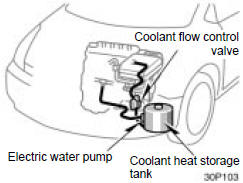
The coolant heat storage tank systemstores hot coolant and feeds it via theelectric water pump automatically to warmthe engine as required. This system helpsgenerate clean emissions. To confirm thecoolant heat storage system check, thepump may operate automatically with thevehicle stopped (in the “OFF” mode).
Although the pump may operate andcause noise while the vehicle is stopped,this does not indicate a malfunction.
CAUTION
- The coolant in this tank is hot evenif the engine and radiator are cold.
- For replacement of the coolant,contact your Toyota dealer.
- Do not touch bolts (9 pieces)painted in yellow.
- In case the bolts are loosened,there is a risk of hot coolant comingout from inside the tank.
- When this has any malfunction, thesurface of this tank gets hot. Toprevent burning yourself, do nottouch the tank.
INFORMATION
In such cases as the time of enginestarting and a short trip after theengine is stopped, the electric waterpump will work for a moment, butthis is no problem.
This is for the preparation for goodemission.
Iridium−tipped spark plugs

Your engine is fitted with iridium−tippedspark plugs.
NOTICE
Use only iridium−tipped spark plugs.Do not adjust gaps for engine performanceor smooth drivability.
Brake system
REGENERATIVE BRAKE
When the brake is applied, the electricmotor used as a generator converts kineticenergy into electric energy.
The regenerative brake works in the followingoperations.
1. When the accelerator pedal is released,the reduced speed equal to enginebraking in a gasoline−fueled vehicleis obtained in accordance with therunning mode position of the shift lever.
2. When the brake pedal is depressedwith the shift lever in “D” or “B”, theregenerative brake works.
HYDRAULIC BRAKE
This brake system has 3 independent hydrauliccircuits. If either circuit should fail,the other will still work. However, the pedalwill be harder to press, and your stoppingdistance will increase. Also, thebrake system warning light may come on.
CAUTION
Do not drive your vehicle with only asingle brake system. Have yourbrakes fixed immediately.
BRAKE ACTUATOR
The brake actuator uses brake fluid pressurizedby the pump to power−assist thebrakes. If the brake actuator fails duringdriving, the brake system warning lightcomes on and buzzer sounds continuously.In this case, the brakes may not workproperly. If they do not work well, depressthe brake pedal firmly. If the brake systemwarning light comes on, immediately stopyour vehicle and contact your Toyota dealer.
The red and yellow brake system warninglight may stay on for about 60 secondsafter the “IG−ON” mode is enabled. It isnormal if the light turns off after a while.
Depressing the brake pedal repeatedlymay turn on the red and yellow brakesystem warning light and buzzer. It is normalif the light turns off and the buzzerstops sounding after a few seconds.
You may hear a small sound in the enginecompartment after the hybrid system isstarted or the brake pedal is depressedrepeatedly. This is a pump pulsatingsound of the brake system, and it is nota malfunction.
In the following conditions, you may heara motor sound in the engine compartment.
- The brake pedal is depressed when thehybrid system is turned off.
- The driver’s door is opened.
- For a few seconds after the hybridsystem is “OFF” and about 90 secondshave passed.
The brake pedal stroke may be shortwhen you press the “POWER” switch withthe brake pedal depressed.
CAUTION
Do not pump the brake pedal if thehybrid system is not operating.Each push on the pedal uses upyour reserved brake fluid pressure.
Even if the power assist is completelylost, the brakes will stillwork. But you will have to push thepedal hard, much harder than normal.And your braking distance willincrease.
ANTI−LOCK BRAKE SYSTEM
The anti−lock brake system is designedto automatically help prevent lock−up ofthe wheels during a sudden braking orbraking on slippery road surfaces. Thisassists in providing directional stabilityand steering performance of the vehicleunder these circumstances.
Effective way to press the ABS brakepedal: When the anti−lock brake systemfunction is in action, the slip indicator inthe instrument cluster flashes and youwill hear a noise. In this situation, to letthe anti−lock brake system work for you,just hold the brake pedal down morefirmly. Do not pump the brake in a panicstop. This will result in reduced brakingperformance.
The anti−lock brake system becomes operativeafter the vehicle has acceleratedto a speed in excess of approximately 10km/h (6 mph). It stops operating when thevehicle decelerates to a speed belowapproximately 5 km/h (3 mph).Depressing the brake pedal on slipperyroad surfaces such as on a manhole cover,a steel plate at a construction site,joints in a bridge, etc. on a rainy daytends to activate the anti−lock brake system.
When the anti−lock brake system is activated,the following condition may occur.They do not indicate a malfunctionof the system:
You may hear the anti−lock brake systemoperating and the vibrations of thevehicle body and steering wheel. Youmay also hear the motor sound in theengine compartment even after the vehicleis stopped.
CAUTION
Do not overestimate the anti−lockbrake system: Although the anti−lockbrake system assists in providing vehiclecontrol, it is still important todrive with all due care and maintaina moderate speed and safe distancefrom the vehicle in front of you, becausethere are limits to the vehiclestability and effectiveness of steeringwheel operation even with the anti−lock brake system on.
If tire grip performance exceeds itscapability, or if hydroplaning occursduring high speed driving in the rain,the anti−lock brake system does notprovide vehicle control.
Anti−lock brake system is not designedto shorten the stopping distance:Always drive at a moderatespeed and maintain a safe distancefrom the vehicle in front of you.Compared with vehicles without ananti−lock brake system, your vehiclemay require a longer stopping distancein the following cases:
- Driving on rough, gravel or snow−covered roads.
- Driving with tire chains installed.
- Driving over the steps such as thejoints on the road.
- Driving on roads where the roadsurface is pitted or has other differencesin surface height.
Install all 4 tires of specified size atappropriate pressure: The anti−lockbrake system detects vehicle speedsusing the speed sensors for respectivewheels’ turning speeds. The useof tires other than specified may failto detect the accurate turning speed,resulting in a longer stopping distance.

Vehicle sold in the U.S.A.

Vehicle sold in Canada
“ABS” warning light
The light comes on when the “IG−ON”mode is enabled. If the anti−lock brakesystem works properly, the light turnsoff after the “READY” light comes on.Thereafter, if the system malfunctions,the light comes on again.
When the “ABS” warning light is on (andthe brake system warning light is on), theanti−lock brake system does not operate,but the brake system still operates conventionally.
If any of the following conditions occurs,this indicates a malfunction somewherein the components monitored bythe warning light system. Contact yourToyota dealer as soon as possible toservice the vehicle.
- The light does not come on when the“IG−ON” mode is enabled, or the“READY” light remains on.
- The light comes on while you are driving.
A warning light turning on briefly duringoperation does not indicate a problem.
CAUTION
If the “ABS” warning light remains ontogether with the red brake systemwarning light, immediately stop yourvehicle at a safe place and contactyour Toyota dealer.
In this case, not only the anti−lockbrake system function and brake assistfunction will fail but also the vehiclewill become extremely unstableduring braking.
Any of the following conditions may occur,but does not indicate a malfunction:
- The light may stay on for about 60seconds after the “IG−ON” mode is enabled.It is normal if it turns off aftera while.
- Depressing the brake pedal repeatedlymay turn on the light. It is normal ifit turns off after a few seconds.
BRAKE ASSIST SYSTEM
When you slam the brakes on, thebrake assist system judges as an emergencystop and provides more powerfulbraking for a driver who cannot holddown the brake pedal firmly.
When you slam the brakes on, more powerfulbraking will be applied. At this time,you may hear a sound in the enginecompartment. This does not indicate amalfunction.
The brake assist system becomes operativeafter the vehicle has accelerated toa speed in excess of approximately 10km/h (6 mph). It stops operating when thevehicle decelerates to a speed belowapproximately 5 km/h (3 mph).
For an explanation of this system’s warninglight, see “Service reminder indicatorsand warning buzzers” on page 125.
Electric power steering system
The electric power steering system, usingan electric motor, assists the turningof the steering wheel.
In the following cases, you may feel thesteering becomes heavy. However, theelectric power steering system warninglight does not come on. (Because it isnot a malfunction.)
When maneuvering the steering frequentlyor keeping the steering wheelturned fully while the vehicle is stoppedor moving very slowly
The power steering effect will be reducedto prevent the system from overheating.Avoid turning the steeringwheel, or stop the vehicle. When youleave the vehicle in the “IG−ON” modefor a while, the system will becomecool.
NOTICE
If you repeat the operation which willturn on the overheating preventionfunction, the electric power steeringsystem may be damaged.
When the 12 volt battery is discharged
Check the 12 volt battery’s condition.If necessary, recharge or replace thebattery. For details, see “Checking 12volt battery condition” on page 418.
When the steering wheel is operatedwith the hybrid system not to be turnedon (with the “READY” light off)
The 12 volt battery capacity is decreasedtemporarily. The system returnsto normal some time after thehybrid system is turned on.
If there is a problem somewhere in theelectric power steering system, the warninglight comes on in the multi−informationdisplay. For details, see “Multi−informationdisplay” on page 133.
When you move the steering wheel, anelectrical motor noise may be heard. Thisis power steering motor noise, and is nota malfunction.
Brake pad wear limit indicators

The brake pad wear limit indicators onyour disc brakes give a warning noisewhen the brake pads are worn to wherereplacement is required.
If you hear a squealing or scraping noisewhile driving, have the brake padschecked and replaced by your Toyotadealer as soon as possible. Expensive rotordamage can result if the pads are notreplaced when necessary.
Your Toyota’s identification
Vehicle identificationnumber

The vehicle identification number (VIN)is the legal identifier for your vehicle.This number is on the left top of theinstrument panel, and can be seenthrough the windshield from outside.
This is the primary identification numberfor your Toyota. It is used in registeringthe ownership of your vehicle.

The vehicle identification number (VIN) isalso on the Certification Label.
Engine and motor number
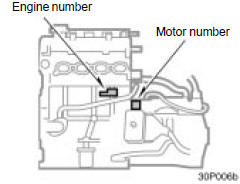
The engine and motor number platesare installed on the engine and transaxlecase as shown.
Theft prevention labels
Your new vehicle carries theft preventionlabels which are approximately 47mm (1.85 in.) by 12 mm (0.47 in.).
The purpose of these labels is to reducethe incidence of vehicle thefts by facilitatingthe tracing and recovery of parts fromstolen vehicles. The label is designed sothat once it is applied to a surface, anyattempt to remove it will result in destroyingthe integrity of the label. Transferringthese labels intact from one part to another,will be impossible.
NOTICE
You should not attempt to remove thetheft prevention labels as it may violatecertain state or federal laws.
Suspension and chassis
CAUTION
Do not modify the suspension/chassiswith lift kits, spacers, springs, etc. Itcan cause dangerous handling characteristics,resulting in loss of control.
Tire information
Tire symbols (Standard tire)
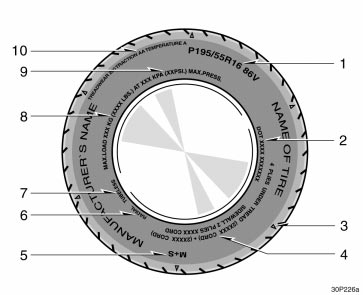
This illustration indicates typical tiresymbols.
1. Tire size—For details, see “Tiresize” on page 338.
2. DOT and Tire IdentificationNumber (TIN)—For details, see“DOT and Tire Identification Number(TIN)” on page 337.
3. Location of tread wear indicators—For details, see “Checkingand replacing tires” on page 411.
4. Tire ply composition and materials—Plies mean a layer of rubber−coated parallel cords. Cords meanthe strands forming the plies in thetire.
5. Summer tire or all seasontire—An all season tire has “M+S”on the sidewall. A tire not markedwith “M+S” is a summer tire. Fordetails, see “Types of tires” onpage 347.
6. Radial tires or bias−ply tires—Aradial tire has “RADIAL” on thesidewall. The tire not marked with“RADIAL” is a bias−ply tire.
7. “TUBELESS” or “TUBE TYPE”—A tubeless tire does not have atube inside the tire and air is directlyfilled in the tire. A tube type tirehas a tube inside the tire and thetube maintains the air pressure.
8. Load limit at maximum cold tireinflation pressure—For details,see “Checking and replacing tires”on page 411.
9. Maximum cold tire inflationpressure—This means the pressureto which a tire may be inflated.For recommended cold tireinflation pressure, see “Tires” onpage 434.
10. Uniform tire quality grading—For details, see “Uniform tire qualitygrading” that follows.
Tire symbols (Compact spare tire)
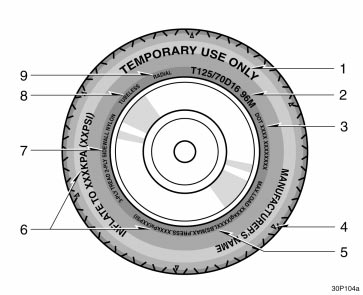
This illustration indicates typical tiresymbols.
1. “TEMPORARY USE ONLY”—Acompact spare tire is identified bythe phrase “TEMPORARY USEONLY” molded into its sidewall.This tire is designed for temporaryemergency use only. For details,see “Compact spare tire” on page366.
2. Tire size—For details, see “Tiresize” on page 338.
3. DOT and Tire IdentificationNumber (TIN)—For details, see“DOT and Tire Identification Number(TIN)” on page 337.
4. Location of tread wear indicators—For details, see “Checkingand replacing tires” on page 411.
5. Load limit at maximum cold tireinflation pressure—For details,see “Checking and replacing tires”on page 411.
6. Maximum cold tire inflationpressure—This means the pressureto which a tire may be inflated.For recommended cold tireinflation pressure, see “Tires” onpage 434.
7. Tire ply composition and materials—Plies mean a layer of rubber−coated parallel cords. Cords meanthe strands forming the plies in thetire.
8. “TUBELESS” or “TUBE TYPE”—A tubeless tire does not have atube inside the tire and air is directlyfilled in the tire. A tube type tirehas a tube inside the tire and thetube maintains the air pressure.
9. Radial tires or bias−ply tires—Aradial tire has “RADIAL” on thesidewall. The tire not marked with“RADIAL” is a bias−ply tire.
DOT and Tire IdentificationNumber (TIN)

This illustration indicates typical DOTand Tire Identification Number (TIN).
1. “DOT” symbol
2. Tire Identification Number (TIN)
3. Tire manufacturer ’s identificationmark
4. Tire size code
5. Manufacturer ’s optional tire typecode (3 or 4 letters)
6. Manufacturing week
7. Manufacturing year
The “DOT” symbol certifies that thetire conforms to applicable FederalMotor Vehicle Safety Standards.
Tire size

This illustration indicates typical tiresize.
1. Tire use (P=Passenger car,T=Temporary use)
2. Section width (in millimeters)
3. Aspect ratio (tire height to sectionwidth)
4. Tire construction code (R=Radial,D=Diagonal)
5. Wheel diameter (in inches)
6. Load index (2 digits or 3 digits)
7. Speed symbol (alphabet with oneletter)

1. Section width
2. Tire height
3. Wheel diameter
Name of each section of tire

1. Bead
2. Sidewall
3. Shoulder
4. Tread
5. Belt
6. Inner liner
7. Reinforcing rubber
8. Carcass
9. Rim lines
10. Bead wires
11. Chafer
Uniform tire quality grading
This information has been preparedin accordance with regulations issuedby the National Highway Traffic SafetyAdministration of the U.S. Departmentof Transportation. It providesthe purchasers and/or prospectivepurchasers of Toyota vehicles with informationon uniform tire quality grading.
Your Toyota dealer will help answerany questions you may have as youread this information.
DOT quality grades—All passengercar tires must conform to FederalSafety Requirements in addition tothese grades. Quality grades canbe found where applicable on thetire sidewall between tread shoulderand maximum section width.For example: Treadwear 200 TractionAA Temperature A.
Tread wear—The tread wear gradeis a comparative rating based on thewear rate of the tire when tested undercontrolled conditions on a specifiedgovernment test course. For example,a tire graded 150 would wearone and a half (1−1/2) times as wellon the government course as a tiregraded 100. The relative performanceof tires depends upon the actualconditions of their use, however, andmay depart significantly from thenorm due to variations in driving habits,service practices and differencesin road characteristics and climate.
Traction AA, A, B, C—The tractiongrades, from highest to lowest, areAA, A, B, and C, and they representthe tire’s ability to stop on wet pavementas measured under controlledconditions on specified governmenttest surfaces of asphalt and concrete.A tire marked C may have poor tractionperformance.
Warning: The traction grade assignedto this tire is based on braking(straight ahead) traction tests anddoes not include cornering (turning)traction.
Temperature A, B, C—The temperaturegrades are A (the highest), B,and C, representing the tire’s resistanceto the generation of heat andits ability to dissipate heat whentested under controlled conditions ona specified indoor laboratory testwheel. Sustained high temperaturecan cause the material of the tire todegenerate and reduce tire life, andexcessive temperature can lead tosudden tire failure. The grade C correspondsto a level of performancewhich all passenger car tires mustmeet under the Federal Motor VehicleSafety Standard No. 109. Grades Band A represent higher levels of performanceon the laboratory test wheelthan the minimum required by law.
Warning: The temperature grades forthis tire are established for a tire thatis properly inflated and not overloaded.Excessive speed, underinflation,or excessive loading, either separatelyor in combination, can causeheat buildup and possible tire failure.
Glossary of tire terminology


Table 1– Occupant loading and distribution for vehicle normal load for various designated seating capacities

Vehicle load limits
Vehicle load limits include total loadcapacity, seating capacity, towing capacityand cargo capacity. Follow theload limits shown below. Total load capacityand seating capacity are alsodescribed on the tire and loading informationlabel. For location of the tireand loading information label, see“Checking tire inflation pressure” onpage 409.
Total load capacity:365 kg (810 lb.)
Total load capacity means combinedweight of occupants, cargo and luggage.
Seating capacity:
Total 5 (Front 2, Rear 3)
Seating capacity means the maximumnumber of occupants whose estimatedaverage weight is 68 kg (150lb.) per person. Depending on theweight of each person, the seating capacitygiven may exceed the totalload capacity.
NOTICE
Even if the number of occupants arewithin the seating capacity, do not exceedthe total load capacity.
Towing capacity
Toyota does not recommend towinga trailer with your vehicle. Your vehicleis not designed for trailer towing.
Cargo capacity
Cargo capacity may increase or decreasedepending on the size (weight)and the number of occupants. For details,see “Capacity and distribution”that follows.
CAUTION
Do not apply the load more thaneach load limit. That may causenot only damage to the tires, butalso deterioration to the steeringability and braking ability, whichmay cause an accident.
Cargo and luggage
Stowage precautions
When stowing cargo and luggage inthe vehicle, observe the following:
Put cargo and luggage in the luggagecompartment when at allpossible. Be sure all items are securedin place.
Be careful to keep the vehicle balanced.Locating the weight as farforward as possible helps maintainbalance.
For better fuel economy, do notcarry unneeded weight.
CAUTION
To prevent cargo and luggagefrom sliding forward duringbraking, do not stack anythingin the luggage compartment.Keep cargo and luggage low,as close to the floor as possible.
Never allow anyone to ride inthe luggage compartment. It isnot designed for passengers.They should ride in their seatswith their seat belts properlyfastened. Otherwise, they aremuch more likely to suffer seriousbodily injury, in the eventof sudden braking or a collision.
Do not place anything on theluggage cover. Such items maybe thrown about and possiblyinjure people in the vehicleduring sudden braking or anaccident. Secure all items in asafe place.
Do not drive with objects lefton top of the instrument panel.They may interfere with thedriver’s field of view. Or theymay move during sharp vehicleacceleration or turning, and impairthe driver’s control of thevehicle. In an accident theymay injure the vehicle occupants.
NOTICE
Do not load the vehicle beyond thevehicle capacity weight given in Section9.
Capacity and distribution
Cargo capacity depends on the totalweight of the occupants.
(Cargo capacity) = (Total load capacity)– (Total weight of occupants)
Steps for Determining CorrectLoad Limit—
(1) Locate the statement “The combinedweight of occupants andcargo should never exceed XXXkg or XXX lbs.” on your vehicle’splacard.
(2) Determine the combined weight ofthe driver and passengers that willbe riding in your vehicle.
(3) Subtract the combined weight ofthe driver and passengers fromXXX kg or XXX lbs.
(4) The resulting figure equals theavailable amount of cargo and luggageload capacity. For example,if the “XXX” amount equals 1400lbs. and there will be five 150 lb.passengers in your vehicle, theamount of available cargo and luggageload capacity is 650 lbs.(1400–750 (5x150)=650 lbs.)
(5) Determine the combined weight ofluggage and cargo being loadedon the vehicle. That weight maynot safely exceed the availablecargo and luggage load capacitycalculated in Step 4.
(6) If your vehicle will be towing atrailer, load from your trailer willbe transferred to your vehicle.Consult this manual to determinehow this reduces the available cargoand luggage load capacity ofyour vehicle.
Toyota does not recommend towinga trailer with your vehicle. Your vehicleis not designed for trailer towing.

Example on Your Vehicle
In case that 2 people with the combinedweight of 166 kg (366 lb.) areriding in your vehicle with the totalload capacity of 365 kg (810 lb.), theavailable amount of cargo and luggageload capacity will be as follows:
365 kg – 166 kg = 199 kg.
(810 lb. – 366 lb. = 444 lb.)
From this condition, if 3 more passengerswith the combined weight of 176kg (388 lb.) get on, the available cargoand luggage load will be reducedas follows:
199 kg – 176 kg = 23 kg.
(444 lb. – 388 lb. = 56 lb.)
As shown in the above example, if thenumber of occupants increases, thecargo and luggage load equaling thecombined weight of occupants whogot on later must be reduced. In otherwords, if the increase in the numberof occupants causes the excess ofthe total load capacity (combinedweight of occupants plus cargo andluggage load), you have to reduce thecargo and luggage on your vehicle.For details about total load capacity,see “Vehicle load limits” on page 344.
CAUTION
Even if the total load of occupant’sweight and the cargo loadis less than the total load capacity,do not apply the load unevenly.That may cause not only damageto the tire but also deteriorationto the steering ability due tounbalance of the vehicle, causingan accident.
Types of tires
Determine what kind of tires yourvehicle is originally equipped with.
1. All season tires
All season tires are designed to providebetter traction in snow and to beadequate for driving in most winterconditions, as well as for use all yearround.
All season tires, however, do not haveadequate traction performancecompared with snow tires in heavy orloose snow. Also, all season tires fallshort in acceleration and handlingperformance compared with summertires in highway driving.
2. Summer tires
Summer tires are high−speed capabilitytires best suited to highway drivingunder dry conditions.
Since summer tires do not have thesame traction performance as snowtires, summer tires are inadequate fordriving on snow−covered or icy roads.For driving on snow−covered or icyroads, we recommend using snowtires. If installing snow tires, be sureto replace all four tires.
The details about how to distinguishsummer tires from all season tires aredescribed on page 334.
CAUTION
Do not mix summer and all seasontires on your vehicle asthis can cause dangerous handlingcharacteristics, resultingin loss of control.
Do not use tire other than themanufacturer’s designatedtires, and never mix tires orwheels of the sizes differentfrom the originally equippedtires and wheels.
Download Manual