If you have a flat tire
1. Reduce your speed gradually,keeping a straight line. Move cautiouslyoff the road to a safe placewell away from the traffic. Avoidstopping on the center divider ofa highway. Park on a level spotwith firm ground.
2. Stop the hybrid system and turnon your emergency flashers.
3. Firmly set the parking brake.
4. Have everyone get out of the vehicleon the side away from traffic.
5. Read the following instructionsthoroughly.
CAUTION
When jacking, be sure to observethe following to reduce the possibilityof death or serious injury:
Follow jacking instructions.
Do not put any part of yourbody under a vehicle supportedby a jack. Personal injurymay occur.
Do not start or run the hybridsystem while your vehicle issupported by the jack.
Stop the vehicle at a level firmground, firmly set the parkingbrake. Block the wheel diagonallyopposite to the one beingchanged if necessary.
Make sure to set the jack properlyin the jack point. Raisingthe vehicle with jack improperlypositioned will damage thevehicle or may allow the vehicleto fall off the jack andcause personal injury.
Never get under the vehiclewhen the vehicle is supportedby the jack alone.
Use the jack only for liftingyour vehicle during wheelchanging.
Do not raise the vehicle withsomeone in the vehicle.
When raising the vehicle, donot place any objects on topof or underneath the jack.
Raise the vehicle only highenough to remove and changethe tire.
NOTICE
Do not continue driving with a deflatedtire. Driving even a short distancecan damage a tire and wheelbeyond repair.

Compact spare tire
The compact spare tire is designedfor temporary emergency use only.
The compact spare tire is identifiedby the distinctive wording “TEMPORARYUSE ONLY” molded into theside wall of the tire.
The compact spare tire saves spacein your luggage compartment, and itslighter weight helps to improve fueleconomy and permits easier installationin case of a flat tire.
The compact spare tire can be usedmany times, if necessary. It has treadlife of up to 4800 km (3000 miles) dependingon road conditions and yourdriving habits. When tread wear indicatorsappear on the tire, replace thetire.
See also the tire information on page411 for details on the tread wear indicatorsand other service information.
CAUTION
The compact spare tire was designedespecially for your Toyota.Do not use it on any othervehicle.
Do not use more than one compactspare tire at the sametime.
Do not exceed 80 km/h (50mph) when driving with thecompact spare tire.
Replace the compact spare tirewith the standard tire as soonas possible.
Avoid sudden acceleration,sudden deceleration and sharpturns with the compact sparetire.
NOTICE
Your ground clearance is reducedwhen the compact spare tire isinstalled so avoid driving over obstaclesand drive slowly on rough, unpavedroads and speed bumps. Also,do not attempt to go through an automaticcar wash as the vehicle mayget caught, resulting in damage.
Required tools and sparetire

1. Get the required tools and sparetire.
1 Wheel nut wrench
2 Jack handle
3 Jack
4 Spare tire
To open the luggage storage box, see“Luggage storage box” on page 315.To prepare yourself for an emergency,you should familiarize yourself withthe use of the jack, each of the toolsand their storage locations.

To remove the jack, unlock the tighteningstrap.
To store the jack, make sure it is securelyheld by the tightening strap.

To remove the spare tire:
1. Remove the luggage storage box.
2. Loosen the bolt and remove it.
3. Remove the jack box.
Then take the spare tire out of thevehicle.
When storing the spare tire, put it inplace with the inner side of the wheelfacing up. Then secure the tire by repeatingthe above removal steps inreverse order to prevent it from flyingforward during a collision or suddenbraking.
When installing the jack box, align thearrows on the jack box with the oneson the body.
Blocking the wheel

2. Block the wheel diagonally oppositethe flat tire to keep thevehicle from rolling when it isjacked up.
When chocking the wheel, place awheel block in front of one of the frontwheels or behind one of the rearwheels.
Loosening wheel nuts

3. Loosen all the wheel nuts.
Always loosen the wheel nuts beforeraising the vehicle.
Turn the wheel nuts counterclockwiseto loosen them. To get maximum leverage,fit the wrench to the nut sothat the handle is on the right side,as shown above. Grab the wrenchnear the end of the handle and pullup on the handle. Be careful that thewrench does not slip off the nut.
Do not remove the nuts yet—just unscrewthem about one−half turn in theorder shown.
CAUTION
Never use oil or grease on thebolts or nuts. The nuts may loosenand the wheels may fall off,which could cause a serious accident.
Positioning the jack
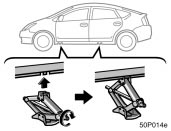
4. Position the jack at the jackpoints as shown.
Make sure the jack is positioned ona level and solid place.
Raising your vehicle

5. After making sure no one is inthe vehicle, raise it high enoughso that the spare tire can beinstalled.
Remember you will need more groundclearance when putting on the sparetire than when removing the flat tire.
To raise the vehicle, insert the jackhandle into the jack (it is a loose fit)and turn it clockwise. As the jacktouches the vehicle and begins to lift,double−check that it is properly positioned.
CAUTION
Never get under the vehicle whenthe vehicle is supported by thejack alone.
Changing wheels

6. Remove the wheel nuts andchange tires.
Lift the flat tire straight off and put itaside.
Roll the spare wheel into position andalign the holes in the wheel with thebolts. Then lift up the wheel and getat least the top bolt started throughits hole. Wiggle the tire and press itback over the other bolts.

Before putting on wheels, remove anycorrosion on the mounting surfaceswith a wire brush or such. Installationof wheels without good metal−to−metalcontact at the mounting surface cancause wheel nuts to loosen and eventuallycause a wheel to come off whiledriving.
Reinstalling wheel nuts

7. Reinstall all the wheel nuts fingertight.
Reinstall the wheel nuts (tapered endinward) and tighten them as much asyou can by hand. Press back on thetire and see if you can tighten themmore.
CAUTION
Never use oil or grease on thebolts or nuts. Doing so may leadto overtightening the nuts anddamaging the bolts. The nutsmay loosen and the wheels mayfall off, which could cause a seriousaccident. If there is oil orgrease on any bolt or nut, cleanit.
Lowering your vehicle

8. Lower the vehicle completelyand tighten the wheel nuts.
Turn the jack handle counterclockwiseto lower the vehicle.
Use only the wheel nut wrench totighten the nuts. Do not use othertools or any additional leverage otherthan your hands, such as a hammer,pipe or your foot. Make sure thewrench is securely engaged over thenut.
Tighten each nut a little at a time inthe order shown. Repeat the processuntil all the nuts are tight.
CAUTION
When lowering the vehicle,make sure all portions of yourbody and all other personsaround will not be injured asthe vehicle is lowered to theground.
Have the wheel nuts tightenedwith torque wrench to 103 N·m(10.5 kgf·m, 76 ft·lbf), as soonas possible after changingwheels. Otherwise, the nutsmay loosen and the wheelsmay fall off, which could causea serious accident.
Do not attach a heavily damagedplastic wheel ornament.It may fly off the wheel andcause accidents while the vehicleis moving.
Stowing flat tire
9. Restow all the tools and jack securely.Then secure the flat tirein the luggage compartmentwith the tire tie−down belts andtie−down hooks as follows
CAUTION
Before driving, make sure all thetools and jack are securely inplace in their storage location toreduce the possibility of personalinjury during a collision orsudden braking.

1. Before stowing the flat tire, removethe center wheel ornament bypushing from the reverse side.
Be careful not to lose the wheel ornament.

2. Put the flat tire on the center ofthe luggage storage box lid withthe outer side of the wheel facingup. Hook one ends of the belts tothe front tie−down hooks.

3. Pass the belts through the centerhole of the wheel as shown above.

4. Attach the other ends of the beltsto the rear tie−down hooks.
After stowing the flat tire, check thatthe tire and belts are secured.
CAUTION
- Make sure the rear seats are intheir original position.
- When carrying the flat tire, secureit using a tire tie−downbelts. Otherwise, the flat tiremay fly out in case of the suddenbraking or an accident, resultingin death or serious injury.
After changing wheels
10. Check the air pressure of the replacedtire.
Adjust the air pressure to the specificationdesignated on page 434. If thepressure is lower than specified, driveslowly to the nearest Toyota dealerand fill to the correct pressure.
Do not forget to reinstall the tire inflationvalve cap as dirt and moisturecould get into the valve core and possiblycause air leakage. If the cap ismissing, have a new one put on assoon as possible.
As soon as possible after changingwheels, tighten the wheel nuts to thetorque specified on page 434 with atorque wrench. Have a technician repairthe flat tire.
After repairing the flat tire, change itwith compact spare tire and reinstallthe wheel ornament.
CAUTION
Take due care in handling the ornamentto avoid unexpected personalinjury.
Download Manual