Engine and Chassis
Checking the engine oil level
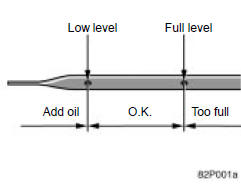
With the hybrid system at operatingtemperature and turned off, check theoil level on the dipstick.
1. To get a correct reading, the vehicleshould be on level ground. After turningoff the hybrid system, wait a few minutesfor the oil to drain back into thebottom of the engine.
2. Pull the dipstick out, hold the rag underthe end and wipe it clean.
3. Reinsert the dipstick—push it in as faras it will go, or the reading will not becorrect.
4. Pull the dipstick out and look at the oillevel while holding a rag under theend.
CAUTION
Be careful not to touch the hot exhaustmanifold.
NOTICE
Be careful not to drop engine oil onthe vehicle components.
If the oil level is below or only slightlyabove the low level, add engine oil ofthe same type as already in the engine.
Remove the oil filler cap and add engineoil in small quantities at a time, checkingthe dipstick. We recommend that you usea funnel when adding oil.
The approximate quantity of oil needed toraise the level between low and full on thedipstick is indicated as follows:
1.5 L (1.6 qt., 1.3 Imp.qt.)
For the engine oil capacity, see “Servicespecifications” on page 431.
When the level reaches within the correctrange, install the filler cap hand−tight.
NOTICE
- Be careful not to spill engine oil onthe vehicle components.
- Avoid overfilling, or the hybrid systemcould be damaged.
- Check the oil level on the dipstickonce again after adding the oil.
ENGINE OIL SELECTION
“Toyota Genuine Motor Oil” is used inyour Toyota vehicle. Use Toyota approved“Toyota Genuine Motor Oil” or equivalentto satisfy the following grade and viscosity.
Oil grade:
ILSAC multigrade engine oil
Recommended viscosity:
SAE 5W−30
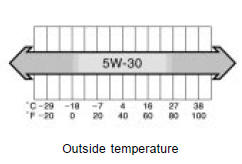
SAE 5W−30 is the best choice, for goodfuel economy, and good starting in coldweather.
If SAE 5W−30 oil is not available, SAE10W−30 oil may be used. However, itshould be replaced with SAE 5W−30 atthe next oil change.

Oil identification mark
The ILSAC (International Lubricant Standardizationand Approval Committee) CertificationMark is added to some oil containersto help you select the oil youshould use.

To ensure excellent lubrication performancefor your engine, “Toyota GenuineMotor Oil” is available, which has beenspecifically tested and approved for allToyota engines.
Please contact your Toyota dealer for furtherdetails about “Toyota Genuine MotorOil”.
Checking the coolant level
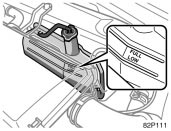
Engine coolant reservoir
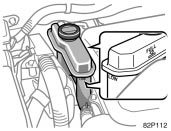
Inverter coolant reservoir
CAUTION
The coolant heat storage tank reacheshigh temperature inside. It is dangerousif hot coolant is discharged whenreplacing. For replacement of thecoolant, contact your Toyota dealer.
Look at the see−through coolant reservoirwhen the hybrid system is cold.The coolant level is satisfactory if it isbetween the “FULL” and “LOW” lineson the reservoir. If the level is low, addthe coolant. (For the coolant type, see“Coolant type selection” described below.)
The coolant level in the reservoir will varywith hybrid system temperature. However,if the level is on or below the “LOW” line,add coolant. Bring the level up to the“FULL” line.
If the coolant level drops within a shorttime after replenishing, there may be aleak in the system. Visually check theradiator, hoses, radiator cap and draincock and water pump.
If you can find no leak, have your Toyotadealer test the cap pressure and checkfor leaks in the cooling system.
If the fluid level in the inverter coolantreservoir is low, there may be a problemwith the cooling system. Have the vehiclechecked by your Toyota dealer.
CAUTION
To prevent burning yourself, do notremove the radiator cap when the engineis hot.
Coolant type selection
Use of improper coolants may damageyour cooling system.
Only use “Toyota Super Long Life Coolant”or similar high quality ethylene glycolbased non−silicate, non−amine, non−nitrite,and non−borate coolant with long−lifehybrid organic acid technology. (Coolantwith long−life hybrid organic acidtechnology is a combination of lowphosphates and organic acids.)
For the U.S.A.—“Toyota Super Long LifeCoolant” is a mixture of 50% coolant and50% deionized water. This coolant providesprotection down to about −35 C(−31 F).
For Canada—“Toyota Super Long LifeCoolant” is a mixture of 55% coolant and45% deionized water. This coolant providesprotection down to about −42 C(−44 F).
NOTICE
Do not use plain water alone.

Toyota recommends “Toyota Super LongLife Coolant”, which has been tested toensure that it will not cause corrosion norresult in malfunction of your coolant systemwith proper usage. “Toyota SuperLong Life Coolant” is formulated withlong−life hybrid organic acid technologyand has been specifically designed toavoid cooling system malfunction onToyota vehicles.
Please contact your Toyota dealer for furtherdetails.
Checking the radiator and condenser
If either of the above parts is extremelydirty or you are not sure of their condition,take your vehicle to a Toyota dealer.
CAUTION
To prevent burning yourself, be carefulnot to touch the radiator or condenserwhen the engine is hot.
NOTICE
To prevent damage to the radiatorand condenser, do not perform thework by yourself.
Checking brake fluid

To check the fluid level, simply look atthe see−through reservoir. The levelshould be between the “MAX” and“MIN” lines on the reservoir.
It is normal for the brake fluid level to godown slightly as the brake pads wear orwhen the fluid level in the accumulator ishigh.
If the level is low, take your vehicle toa Toyota dealer as soon as possible. Donot drive if the red brake system warninglight is on. Call a Toyota dealer forassistance.
If the fluid level goes down soon afteryour vehicle is serviced, it may indicatea serious mechanical problem.
CAUTION
Brake fluid can harm your hands oreyes. If fluid gets on your hands orin your eyes, flush the affected areawith clean water immediately. If youstill feel uncomfortable with yourhands or eyes, go to the doctor.
NOTICE
If you spill some of the fluid, be sureto wipe it off to prevent it from damagingthe parts or paintwork.
Checking tire inflation pressure

Keep your tire inflation pressuresat the proper level.
The recommended cold tire inflationpressures, tire sizes and the combinedweight of occupants and cargo(vehicle capacity weight) are describedon pages 430 and 434. Theyare also described on the tire andloading information label as shown.
You should check the tire inflationpressure every two weeks, or at leastonce a month. And do not forget thespare!
The following instructions forchecking tire inflation pressureshould be observed:
- The pressure should bechecked only when the tires arecold. If your vehicle has beenparked for at least 3 hours and hasnot been driven for more than 1.5km or 1 mile since, you will getan accurate cold tire inflation pressurereading.
- Always use a tire inflation pressuregauge. The appearance ofa tire can be misleading. Besides,tire inflation pressures that areeven just a few pounds off can degraderide and handling.
- Take special care when addingair to the compact spare tire.The smaller tire size can gainpressure very quickly. Add compressedair in small quantities andcheck the pressure often until itreaches the specified pressure.
- Do not bleed or reduce tireinflation pressure after driving.It is normal for the tire inflationpressure to be higher after driving.
- Never exceed the vehicle capacityweight. Passenger and luggageweight should be located sothat the vehicle is balanced.
INSPECTION AND ADJUSTMENTPROCEDURE

1. Remove the tire valve cap.
2. Press the tip of the tire inflationpressure gauge to the tire valve.
3. Read the pressure using the graduationsof the gauge.
4. In case the tire inflation pressureis not within the prescribed range,insert the compressed air from thevalve. In case of applying too muchair, press the center of the valveand release the air to adjust.
5. After completing the tire inflationpressure measurement and adjustment,apply soapy water to thevalve and check for leakage.
6. Install the tire valve cap.If a gauge and air pump are not available,have your vehicle checked byyour Toyota dealer.
CAUTION
Be sure to reinstall the tire valvecaps. Without the valve caps, dirtor moisture could get into thevalve core and cause air leakage.If the caps have been lost, havenew ones put on as soon as possible.Incorrect tire inflation pressuremay waste fuel, reduce the comfortof driving, reduce tire life andmake your vehicle less safe todrive.
If a tire frequently needs refilling,have it checked by your Toyota dealer.
CAUTION
Keep your tires properly inflated.Otherwise, the following conditionsmay occur and cause an accidentresulting in death or seriousinjuries.
Low tire pressure (underinflation)—
- Excessive wear
- Uneven wear
- Poor handling
- Possibility of blowouts from anoverheated tire
- Poor sealing of the tire bead
- Wheel deformation and/or tireseparation
- A greater possibility of tiredamage from road hazards
High tire pressure (overinflation)—
- Poor handling
- Excessive wear
- Uneven wear
- A greater possibility of tiredamage from road hazards
Checking and replacing tires

CHECKING YOUR TIRES
Check the tire’s tread for treadwear indicators. If the indicatorsshow, replace the tires. The locationof tread wear indicators isshown by the “TWI” or “D” marks,etc., molded on the sidewall ofeach tire.
The tires on your Toyota have built−intread wear indicators to help youknow when the tires need replacement.When the tread depth wears to1.6 mm (0.06 in.) or less, the indicatorswill appear. If you can see theindicators in two or more adjacentgrooves, the tire should be replaced.The lower the tread, the higher therisk of skidding.
The effectiveness of snow tires islost if the tread wears down below4 mm (0.16 in.).
If you have tire damage such ascuts, splits, cracks deep enough toexpose the fabric, or bulges indicatinginternal damage, the tireshould be replaced.
If a tire often goes flat or cannot beproperly repaired due to the size orlocation of a cut or other damage, itshould be replaced. If you are notsure, consult with your Toyota dealer.
If air loss occurs while driving, do notcontinue driving. Driving even a shortdistance can damage a tire beyondrepair.
Any tires which are over 6 yearsold must be checked by a qualifiedtechnician even if damage is notobvious.
Tires deteriorate with age even if theyhave never or seldom been used.This applies also to the spare tire andtires stored for future use.
REPLACING YOUR TIRES
When replacing a tire, use a tire ofthe same size and construction,and the same or greater load capacityas the originally installedtires.
Using any other size or type of tiremay seriously affect handling, ride,speedometer/odometer calibration,ground clearance, and clearance betweenthe body and tires or snowchains.
Check that the maximum load of thereplaced tire is greater than 1/2 of theGross Axle Weight Ratings (GAWR)of either the front axle or the rearaxle, whichever is greater. As for themaximum load of the tire, see the loadlimit at maximum cold tire inflationpressure mentioned on the sidewallof the tire, and as for the Gross AxleWeight Ratings (GAWR), see the CertificationLabel. For details about thesidewall of the tire and the CertificationLabel, see pages 334 and 332.
CAUTION
Observe the following instructions.Otherwise, an accidentmay occur resulting in death orserious injuries.
- Do not mix radial, bias belted,or bias−ply tires on your vehicle,as this may cause dangeroushandling characteristicsresulting in loss of control.
- Do not use tires other than themanufacturer’s recommendedsize, as this may cause dangeroushandling characteristicsresulting in loss of control.
Toyota recommends all four tires,or at least both front or rear tiresbe replaced at a time as a set.
See “If you have a flat tire” on page365 for tire change procedure.
When a tire is replaced, the wheelshould always be balanced.
An unbalanced wheel may affect vehiclehandling and tire life. Wheelscan get out of balance with regularuse and should therefore be balancedoccasionally.
When replacing a tubeless tire, theair valve should also be replacedwith a new one.
Rotating tires

To equalize tire wear and help extendtire life, Toyota recommendsthat you rotate your tires accordingto the maintenance schedule.(For scheduled maintenance information,please refer to the “ScheduledMaintenance Guide” or “Owner’sManual Supplement”.)However, the most appropriate timingfor tire rotation may vary accordingto your driving habits androad surface conditions.
The wheel assemblies must be rotatedas illustrated above.
When rotating tires, check for unevenwear and damage. Abnormal wear isusually caused by incorrect tire inflationpressure, improper wheel alignment,out−of−balance wheels, or severebraking.
CAUTION
Do not include a compact sparetire when rotating the tires. It isdesigned for temporary use only.
Installing snow tires and chains
WHEN TO USE SNOW TIRES ORCHAINS
Snow tires or chains are recommendedwhen driving on snow or ice.On wet or dry roads, conventional tiresprovide better traction than snow tires.
SNOW TIRE SELECTION
If you need snow tires, select tires ofthe same size, construction and loadcapacity as the originally installed tires.Do not use tires other than those mentionedabove. Do not install studded tireswithout first checking local regulations forpossible restrictions.
CAUTION
Do not use snow tires other than themanufacturer’s recommended size, asthis may cause dangerous handlingcharacteristics resulting in loss ofcontrol. Otherwise, an accident mayoccur resulting in death or seriousinjuries.
SNOW TIRE INSTALLATION
Snow tires should be installed on allwheels.
Installing snow tires on the front wheelsonly can lead to an excessive differencein road grip capability between the frontand rear tires which could cause loss ofvehicle control.
When storing removed tires, you shouldstore them in a cool dry place.Mark the direction of rotation and be sureto install them in the same direction whenreplacing.
CAUTION
Do not drive with the snow tiresincorrectly inflated.
Never drive over 120 km/h (75 mph)with any type of snow tires.
TIRE CHAIN SELECTION
Regulations regarding the use of tirechains vary according to location ortype of road, so always check local regulationsbefore installing chains.
Use SAE Class “S” type radial tire chains,with the exception of radial cable chainsor V−bar type chains.
CHAIN INSTALLATION
Install the chains on the front tires astightly as possible. Do not use tirechains on the rear tires. Retightenchains after driving 0.5 − 1.0 km (1/4 −1/2 mile).
When installing chains on your tires, carefullyfollow the instructions of the chainmanufacturer.
If wheel covers are used, they will bescratched by the chain band, so removethe covers before putting on the chains.
CAUTION
- Do not exceed 50 km/h (30 mph) orthe chain manufacturer’s recommendedspeed limit, whichever islower.
- Drive carefully avoiding bumps,holes, and sharp turns, which maycause the vehicle to bounce.
- Avoid sharp turns or locked−wheelbraking, as use of chains may adverselyaffect vehicle handling.
- When driving with chains installed,be sure to drive carefully. Slowdown before entering curves toavoid losing control of the vehicle.Otherwise an accident may occur.
NOTICE
Do not attempt to use a tire chain onthe compact spare tire, as it may resultin damage to the vehicle as wellas the tire.
Replacing wheels
WHEN TO REPLACE YOUR WHEELS
If you have wheel damage such asbending, cracks or heavy corrosion, thewheel should be replaced.
If you fail to replace a damaged wheel,the tire may slip off the wheel or causeloss of handling control.
WHEEL SELECTION
When replacing wheels, care should betaken to ensure that the wheels are replacedby ones with the same load capacity,diameter, rim width, and offset.
This must be observed on compact sparetire, too.
Correct replacement wheels are availableat your Toyota dealer.
A wheel of a different size or type mayadversely affect handling, wheel and bearinglife, brake cooling, speedometer/odometercalibration, stopping ability, headlightaim, bumper height, vehicle ground clearance,and tire or snow chain clearance tothe body and chassis.
Replacement with used wheels is not recommendedas they may have been subjectedto rough treatment or high mileageand could fail without warning. Also, bentwheels which have been straightened mayhave structural damage and thereforeshould not be used. Never use an innertube in a leaking wheel which is designedfor a tubeless tire.
Aluminum wheel precautions
- When installing aluminum wheels,check that the wheel nuts are tightafter driving your vehicle the first 1600km (1000 miles).
- If you have rotated, repaired, orchanged your tires, check that thewheel nuts are still tight after driving1600 km (1000 miles).
- When using tire chains, be careful notto damage the aluminum wheels.
- Use only Toyota wheel nuts andwrench designed for your aluminumwheels.
- When balancing your wheels, use onlyToyota balance weights or equivalentand a plastic or rubber hammer.
- As with any wheel, periodically checkyour aluminum wheels for damage. Ifdamaged, replace immediately.
Electrical components
Type: Nickel−Metal hydride battery
Voltage: 7.2 V
Capacity: 6.5 Ah (3HR)
Quantity: 28
Overall voltage: 201.6 V
Download Manual