Tires and wheels
You should be familiar with the type of tires present on your vehicle.
All season tires are designed to provide an adequate measure of traction, handling and braking performance in year-round driving including snowy and icy road conditions. However, all season tires do not offer as much traction performance as winter (snow) tires in heavy or loose snow or on icy roads.
All season tires are identified by “ALL SEASON” and/or “M+S” (Mud & Snow) on the tire sidewall.
Summer tires are high-speed capability tires best suited for highway driving under dry conditions.
Summer tires are inadequate for driving on slippery roads such as on snow-covered or icy roads.
If you drive your vehicle on snow-covered or icy roads, we strongly recommend the use of winter (snow) tires.
When installing winter tires, be sure to replace all four tires.
Winter tires are best suited for driving on snow-covered and icy roads. However, winter tires do not perform as well as summer tires and all season tires on roads other than snow-covered and icy roads.
The tire pressure monitoring system pro- vides the driver with a warning message by sending a signal from a sensor that is installed in each wheel when tire pressure is severely low. The tire pressure monitor- ing system will activate only when the vehicle is driven. Also, this system may not react immediately to a sudden drop in tire pressure (for example, a blow-out caused by running over a sharp object).
If you adjust the tire pressures in a warm garage and will then drive the vehicle in cold outside air, the resulting drop in tire pressures may cause the low tire pressure warning light to illuminate. To avoid this problem when adjusting the tire pressures in a warm garage, inflate the tires to pressures higher than those shown on the tire placard. Specifically, inflate them by an extra 1 psi (6.9 kPa, 0.07 kgf/cm2) for every difference of 108F (5.68C) between
the temperature in the garage and the temperature outside. By way of example, the following table shows the required tire pressures that correspond to various out- side temperatures when the temperature in the garage is 608F (15.68C).
Tire size: 225/60R17 99H Standard tire pressures:
Front: 33 psi (230 kPa, 2.3 kgf/cm2)
Rear: 32 psi (220 kPa, 2.2 kgf/cm2) Garage temperature: 608F (15.68C)
|
Outside temperature |
Adjusted pressure [psi (kPa, kgf/cm2)] |
|
|
Front |
Rear |
|
|
308F (−18C) |
36 (250, 2.5) |
35 (240, 2.4) |
|
108F (−128C) |
38 (265, 2.65) |
37 (255, 2.55) |
|
−108F (−238C) |
41 (280, 2.8) |
39 (270, 2.7) |
If the low tire pressure warning light illuminates when you drive the vehicle in cold outside air after adjusting the tire pressures in a warm garage, re-adjust the tire pressures using the method described above. Then, increase the vehicle speed to at least 20 mph (32 km/h) and check to see that the low tire pressure warning light turns off a few minutes later. If the low tire
pressure warning light does not turn off, the tire pressure monitoring system may not be functioning normally. In this event, go to a SUBARU dealer to have the system inspected as soon as possible.
While the vehicle is driven, friction be- tween tires and the road surface causes the tires to warm up. After illumination of the low tire pressure warning light, any increase in the tire pressures caused by an increase in the outside air temperature or by an increase in the temperature in the tires can cause the low tire pressure warning light to turn off.
System resetting is necessary when the wheels are changed (for example, a switch to snow tires) and new TPMS valves are installed on the newly fitted wheels. Have this work performed by a SUBARU dealer following wheel replacement.
It may not be possible to install TPMS valves on certain wheels that are on the market. Therefore, if you change the wheels (for example, a switch to snow tires), use wheels that have the same part number as the standard-equipment wheels. Without four operational TPMS valve/sensors on the wheels, the TPMS will not fully function and the warning light on the combination meter will illuminate steadily after blinking for approximately 1
minute.
When a tire is replaced, adjustments are necessary to ensure continued normal operation of the tire pressure monitoring system. Therefore, as with wheel replace- ment, you should have the work performed by a SUBARU dealer.
NOTE
. When the wheels and tires strike curbs or are subjected to harsh treatment as when the vehicle is driven on a rough surface, they can suffer damage that cannot be seen with the naked eye. This type of damage does not become evident until time has passed. Try not to drive over curbs, potholes or on other rough surfaces. If doing so is unavoidable, keep the vehicle’s speed down to a walking pace or less, and approach the curbs as squarely as possible. Also, make sure the tires are not pressed against the curb when you park the vehicle.
. If you feel unusual vibration while driving or find it difficult to steer the vehicle in a straight line, one of the tires and/or wheels may be damaged. Drive slowly to the nearest authorized SUBARU dealer and have the vehicle in- spected.
Maintaining the correct tire pres- sures helps to maximize the tires’ service lives and is essential for good running performance. Check and, if necessary, adjust the pres- sure of each tire and the spare (if equipped) at least once a month and before any long journey.
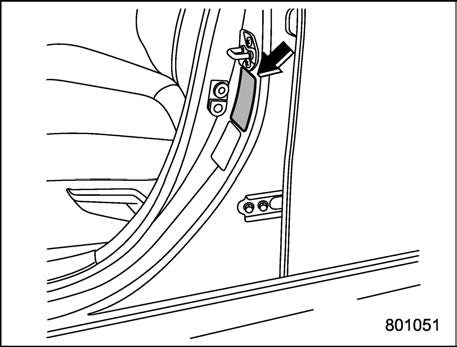
Tire placard
Check the tire pressures when the tires are cold. Use a pressure gauge to adjust the tire pressures to the values shown on the tire placard. The tire placard is located on the door pillar on the driver’s side.
Driving even a short distance warms up the tires and increases the tire pressures. Also, the tire pressures are affected by the out- side temperature. It is best to check tire pressure outdoors before driv- ing the vehicle.
When a tire becomes warm, the air inside it expands, causing the tire pressure to increase. Be careful not to mistakenly release air from a warm tire to reduce its pressure.
NOTE
when the vehicle has been parked for at least three hours or has been driven less than 1 mile (1.6 km).
Incorrect tire pressures detract from controllability and ride comfort, and they cause the tires to wear abnor- mally.
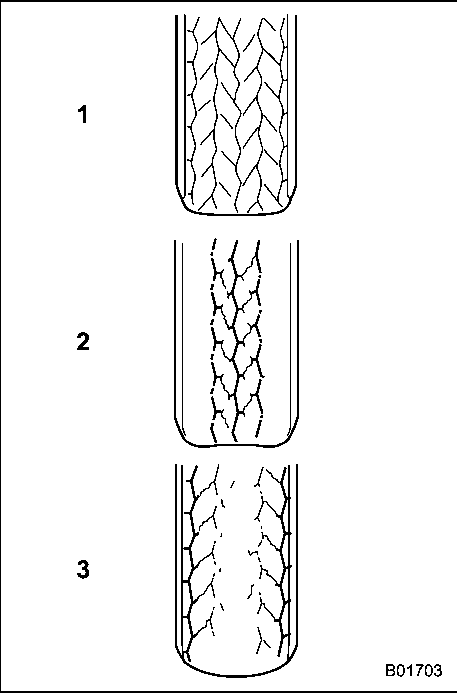
Roadholding is good, and steering is responsive. Rolling resistance is low, so fuel con- sumption is also lower.
Rolling resistance is high, so fuel consumption is also high- er.
Ride comfort is poor. Also, the tire magnifies the effects of road-surface bumps and dips, possibly resulting in vehicle damage.
If the tire placard shows tire pres- sures for the vehicle when fully loaded, adjust the tire pressures to the values that match the loading conditions.
Each wheel was correctly balanced when your vehicle was new, but the wheels will become unbalanced as the tires become worn during use. Wheel imbalance causes the steer- ing wheel to vibrate slightly at certain vehicle speeds and detracts from the vehicle’s straight-line sta- bility. It can also cause steering and suspension system problems and abnormal tire wear. If you suspect that the wheels are not correctly balanced, have them checked and adjusted by your SUBARU dealer. Also have them adjusted after tire repairs and after tire rotation.
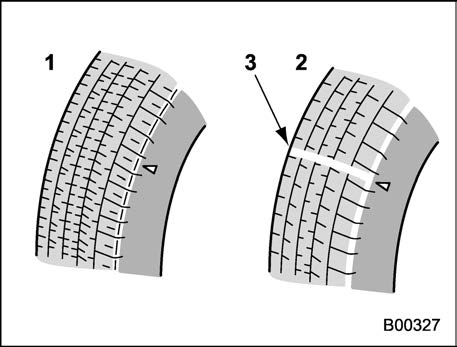 & Wear indicators
NOTE
The suspension system is de- signed to hold each wheel at a certain alignment (relative to the other wheels and to the road) for optimum straight-line stability and cornering performance.
Each tire incorporates a tread wear indicator, which becomes visible when the depth of the tread grooves decreases to 0.063 in (1.6 mm). A tire must be replaced when the tread wear indicator appears as a solid band across the tread.
NOTE
For safety, inspect tire tread regularly and replace the tires before their tread wear indicators become visible.
& Rotational direction of tires
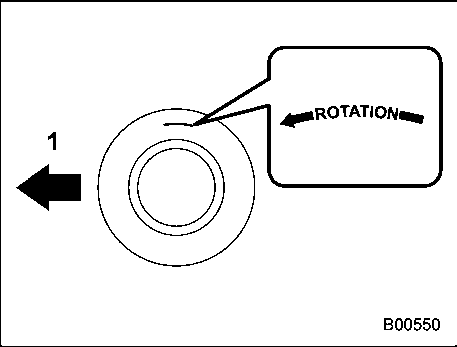
Example of rotational direction marked on the sidewall
If the tires have specific rotational direction, refer to the arrow marked on the side wall.
The arrow should be pointing for- ward direction when the wheels are fitted.
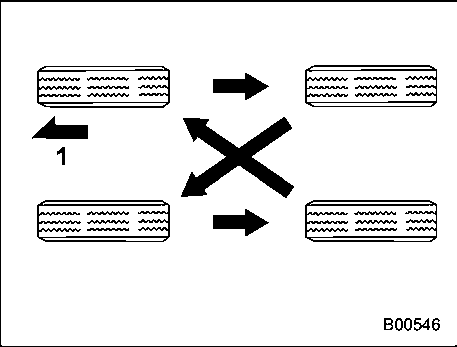
Vehicles equipped with 4 non- unidirectional tires
1) Front
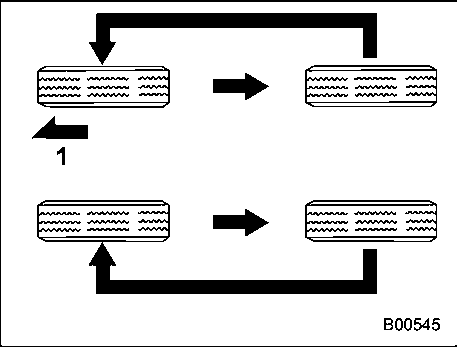
Vehicles equipped with unidir- ectional tires
1) Front
Tire wear varies from wheel to wheel. Move the tires to the posi- tions shown in the illustration each time they are rotated. For the tire rotation schedule, refer to the “War- ranty and Maintenance Booklet”.
Replace any damaged or unevenly worn tires at the time of rotation. After tire rotation, adjust the tire pressures and make sure the wheel nuts are correctly tightened.
After driving approximately 600 miles (1,000 km), check the wheel nuts again and retighten any nut that has become loose.
For handling alloy wheels, refer to “Alloy wheels” P481.
The wheels and tires are important and integral parts of your vehicle’s design; they cannot be changed arbitrarily. The tires fitted as standard equipment are optimally matched to the characteristics of the vehicle and were selected to give the best possible combination of running perfor- mance, ride comfort, and service life. It is essential for every tire to have a size and construction matching those shown on the tire placard and to have a speed symbol and load index matching those shown on the tire placard.
Using tires of a non-specified size detracts from controllability, ride comfort, braking performance, speedometer accuracy and odometer accuracy. It also creates incor- rect body-to-tire clearances and inappro- priately changes the vehicle’s ground clearance.
All four tires must be the same in terms of manufacturer, brand (tread pattern), con-
struction, and size. You are advised to replace the tires with new ones that are identical to those fitted as standard equip- ment.
For safe vehicle operation, SUBARU recommends replacing all four tires at the same time.
When replacing wheels due, for example, to damage, make sure the replacement wheels match the specifications of the wheels that are fitted as standard equip- ment. Replacement wheels are available at your SUBARU dealer.
Alloy wheels 481
Download Manual