Disclaimer: Not affiliated with or endorsed by Ford Motor Company. For informational purposes only. Full Disclaimer
Basic Ford F-150 Engine Swap Compatibility Guidelines
Updated:Before you start researching parts and pricing, check whether the swap you have in mind actually fits — and whether it's worth doing.
Check My Engine SwapEngine interchange is a polarizing topic in the Ford F-150 community. Some people argue that the power and performance upgrade is not worth the risks and resources involved, while others believe that it's worthwhile.
Our Ford F-150 engine interchange chart will provide you with a comprehensive engine information. By searching through this chart, you can not only find out what engine you have in your vehicle but also discover other available options. They include engines used in this very model across the trims and years or even engines from similar models and makes.
Being a true classic masterpieces, project cars often involve some major power upgrades. And even unlucky F-150 owners with dead motors can actually subvert this situation to their own benefit and swap the original engine with another compatible option, simultaneously upgrading the overall performance.
Regardless of the reason why you would want to swap your old engine for a different one, this feat can be both risky and exhausting without understanding these engine interchange guidelines.

What Engines Can You Put in your Ford F-150?
The engine you can put in your Ford F-150 depends on several factors, including the year of your vehicle, the engine size and configuration, and local emissions regulations. However, the most important thing to consider before interchanging engines is their compatibility with other systems inside your vehicle.
This process involves so much more work than just taking one engine and replacing it with another of the same size. The new engine must fit perfectly with an electrical system, fuel lines, cooling, intake and exhaust, drivetrain, and so many more.
Because of these factors, the engines can be roughly divided into two major categories. First, engines that are relatively easy to swap. They are like a plug&play option that can be found in an engine swap compatibility chart. And second, engines that can be integrated into the existing systems with some extra effort and modifications.
Luckily, there is a useful and informative tool that can help you find out what engines you can put in your Ford F-150 without too much work. This “tool” is an engine swap compatibility chart you can find below.
Hopefully, this will make your research easier and more efficient. Within a few minutes, you can discover which vehicle is using the same engine as yours and make informed decisions about maintenance, repairs, upgrades, and more.
Ford F-150 Engine Swap Compatibility Chart
| Ford / V6 / Ecoboost - Petrol / 3.5L / 3.5L Ecoboost Turbo | |
|---|---|
| Ford Expedition, | 2015, 2016, 2017, 2018, 2019, 2020, 2021, 2022, 2023 |
| Ford Explorer, | 2013, 2014, 2015, 2016, 2017, 2018, 2019 |
| Ford F-150, | 2011, 2012, 2013, 2014, 2015, 2016, 2017, 2018, 2019, 2020, 2021, 2022, 2023 |
| Ford Flex, | 2010, 2011, 2012, 2013, 2014, 2015, 2016, 2017, 2018, 2019 |
| Ford Taurus, | 2010, 2011, 2012, 2013, 2014, 2015, 2016, 2017, 2018, 2019 |
| Lincoln MKS, | 2010, 2011, 2012, 2013, 2014, 2015, 2016 |
| Lincoln MKT, | 2010, 2011, 2012, 2013, 2014, 2015, 2016, 2017, 2018, 2019 |
| Lincoln Navigator | 2015, 2016, 2017, 2018, 2019, 2020, 2021, 2022 |
| Ford / V6 / Duratec - Petrol / 3.7L / Duratec 37 | |
|---|---|
| Ford Edge, | 2011, 2012, 2013, 2014, 2015 |
| Ford F-150, | 2011, 2012, 2013, 2014 |
| Ford Mustang, | 2011, 2012, 2013, 2014, 2015, 2016, 2017 |
| Lincoln Continental, | 2017, 2018, 2019, 2020 |
| Lincoln MKS, | 2009, 2010, 2011, 2012, 2013, 2014, 2015, 2016 |
| Lincoln MKT, | 2010, 2011, 2012, 2013, 2014, 2015, 2016, 2017, 2018, 2019 |
| Lincoln MKZ, | 2013, 2014, 2015, 2016 |
| Mazda CX-9, | 2008, 2009, 2010, 2011, 2012, 2013, 2014, 2015 |
| Mazda Mazda6 | 2009, 2010, 2011, 2012, 2013 |
| Ford / V-8 / Modular - Petrol / Coyote / 5.0L Coyote | |
|---|---|
| Ford F-150, | 2011, 2012, 2013, 2014, 2015, 2016, 2017, 2018, 2019, 2020, 2021, 2022, 2023 |
| Ford Mustang | 2011, 2012, 2013, 2014, 2015, 2016, 2017, 2018, 2019, 2020, 2021, 2022 |
| Ford / V-8 / Boss - Petrol / 2-Valve / 6.2L Boss | |
|---|---|
| Ford F-150, | 2011, 2012, 2013, 2014 |
| Ford F-250, | 2011, 2012, 2013, 2014, 2015, 2016, 2017, 2018, 2019, 2020, 2021, 2022 |
| Ford F-350 | 2011, 2012, 2013, 2014, 2015, 2016, 2017, 2018, 2019, 2020, 2021, 2022 |
| Ford / V-8 / Modular - Petrol / 4.6 L / 4.6 L 2-Valve | |
|---|---|
| Ford Expedition, | 1999, 2000, 2001, 2002, 2003, 2004 |
| Ford Explorer, | 2002, 2003, 2004, 2005, 2006, 2007, 2008, 2009, 2010 |
| Ford F-150, | 1999, 2000, 2001, 2002, 2003, 2004, 2005, 2006, 2007, 2008, 2009, 2010 |
| Ford F-250, | 1999 |
| Ford Mustang, | 1999, 2000, 2001, 2002, 2003, 2004, 2005, 2006, 2007, 2008, 2009, 2010 |
| Lincoln Aviator | 2003, 2004, 2005 |
| Ford / V-8 / Modular - Petrol / Triton / 5.4L Triton | |
|---|---|
| Ford Expedition, | 1999, 2000, 2001, 2002, 2003, 2004, 2005, 2006, 2007, 2008, 2009, 2010, 2011, 2012, 2013, 2014 |
| Ford F-150, | 1999, 2000, 2001, 2002, 2003, 2004, 2005, 2006, 2007, 2008, 2009, 2010 |
| Ford F-250, | 1999, 2000, 2001, 2002, 2003, 2004, 2005, 2006, 2007, 2008, 2009, 2010 |
| Ford F-350, | 1999, 2000, 2001, 2002, 2003, 2004, 2005, 2006, 2007, 2008, 2009, 2010 |
| Lincoln Navigator | 1999, 2000, 2001, 2002, 2003, 2004, 2005, 2006, 2007, 2008, 2009, 2010, 2011, 2012, 2013, 2014 |
| Ford / V6 / Essex V6 - Petrol / 4.2 / ESG-642 | |
|---|---|
| Ford F-150 | 1999, 2000, 2001, 2002, 2003, 2004, 2005, 2006, 2007, 2008 |
| Ford / V6 / Ecoboost - Petrol / 2.7L / 2.7L EcoBoost Nano | |
|---|---|
| Ford Bronco, | 2021, 2022 |
| Ford Edge, | 2015, 2016, 2017, 2018, 2019, 2020, 2021, 2022, 2023 |
| Ford F-150, | 2015, 2016, 2017, 2018, 2019, 2020, 2021, 2022, 2023 |
| Ford Fusion, | 2017, 2018, 2019 |
| Lincoln Continental | 2017, 2018, 2019, 2020 |
| Ford / V6 / Duratec - Petrol / 3.3L / Duratec 33 | |
|---|---|
| Ford Explorer, | 2020, 2021, 2022, 2023 |
| Ford F-150 | 2018, 2019, 2020, 2021, 2022, 2023 |
| Ford / V6 / Power Stroke - Diesel / 3.0L / 3.0L Turbo Diesel | |
|---|---|
| Ford F-150 | 2018, 2019, 2020, 2021 |
Learning about your current engine is a good starting point. We have some useful tips for that too. So read on to find out how to know what engine your vehicle has and where to get the name and specifications.
What Kind of Engine Does my F-150 Have?
It is important to understand what engine your Ford F-150 has and what characteristics it has before you can actually look for an interchangeable option. This step is the easiest one, but there are multiple ways for you to find the engine specifications.
To determine the engine name and type under the hood of your vehicle, you can follow these simple steps:
- Locate the engine information placard. This is typically found on the engine itself, the firewall, or the radiator support. It should list the engine name and type, as well as its size and specifications.
- Consult the owner's manual. The owner's manual always includes a few passages about the engine, including its specifications, name and type. Be careful, though, if your car has been in use. The manual may be misleading if the previous owner decided to modify the vehicle.
- Look for the engine code. The engine code is typically a series of letters and numbers stamped on the engine block. You can use this code to look up the engine specifications online or consult a dealership or mechanic.
IMPORTANT NOTE!
Keep in mind that some older vehicles, especially used ones, may have had engine swaps or modifications before you even purchased them. So it's possible that the engine under the hood of your Ford F-150 may not match the one listed in the vehicle's manual or information placard. In this case, it may be best to consult a mechanic or specialist.
How do I know if an engine will fit in my Ford F-150?
An engine swap can be a hit or miss, but it definitely shouldn't. To get the best performance with a new engine, you should take your time with deep research.
Of course, consulting a specialist is a must, but before you do that, you should become acquainted with some crucial elements and their influence on your project.
It can be difficult to determine if an engine will fit in your Ford F-150 without doing a thorough check of compatibility with the systems tightly linked to the engine. Here is a list of ten things that determine whether the engine fits your vehicle and how it will perform.
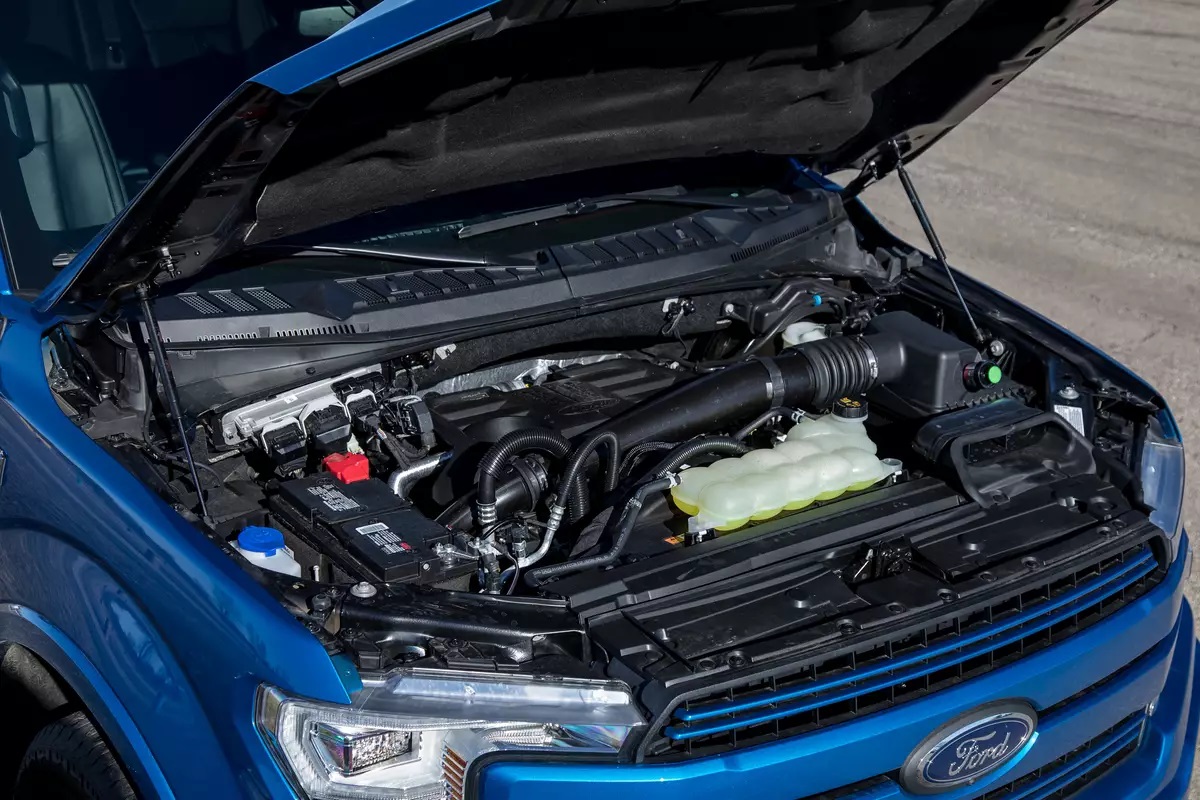
Axles and Drivetrain
You can guess why the engine's size and output must match the capacity of the axles and drivetrain since they are basically responsible for converting the engine's rotational power into the linear motion that moves the wheels. If the torque and power are too much for them to bear, these OEM parts must be replaced with aftermarket options to accommodate the Ford F-150 engine swap.
To successfully replace your transmission, front-wheel drive swaps necessitate axles that can bridge the gap between the transaxle/intermediate shaft and front wheel hubs.
For rear-wheel drive replacements, however, a custom driveshaft has to be tailored specifically for your Ford F-150 with joints compatible on both ends - one end being connected to the new transmission's yoke while the other connects to its existing U-joint of your rear end.
Pedal Assembly
Engine interchange on Ford F-150 requires some work on gearboxes and pedals which often involves more than a simple cable swap. Older, cable-driven throttle bodies simply need the appropriate cable. However, electronically controlled versions can be complex, requiring an ECU, pedal assembly and wiring.
Clutch pedals come in two varieties. Cable-operated assemblies may be able to reuse the car's original cable for modern transmissions. To retrofit newer hydraulically controlled transmissions into older chassis, an adapter line to connect the clutch slave cylinder must be made as well as an adapter kit including pedal assembly, master cylinder and reservoir.
Hydraulically operated gearboxes can also be placed into older chassis that feature cable-operated transmissions with similar requirements.
Enter your vehicle and target engine to see a compatibility verdict, estimated cost, required changes, and whether it's the right move.
Get My Swap VerdictShifter
An engine swap can be an incredibly rewarding project, but it's important to ensure compatibility between the Ford F-150 and the donor vehicle. To guarantee a seamless integration of your engine, it is essential to make sure that the shifter tunnel fits with the new components. If you mix and match parts from different cars, you may run into difficulties later on. To prevent unnecessary snags in this process, be certain to acquire all of your elements from one donor vehicle only.
Fuel System
Fuel system compatibility issues may arise when interchanging engines in a Ford F-150 because of differences in the fuel delivery systems and components between the two engines.
Keep in mind that different motors can possibly have different fuel injection systems, pumps, filters, tanks, fuel lines and hoses. These parts can be located in different places, making it harder to fit another engine in the same place. Or they might be unable to keep up with the new engine's appetites. In either case, it is best to consult a specialist who can navigate you through this convoluted system.
Keeping these issues in check is vital. Any leak can potentially lead to engine failure, fire and other dangerous accidents.
Cooling System
The catch with a bigger engine fitment is that it requires more cold air intake but leaves less space to upgrade it. An electric cooling fan can be beneficial for larger engines and those in confined spaces. To ensure the air passes through the radiator, the fan must be reversed in terms of polarity and direction. Additionally, depending on your F-150’s engine, custom radiator hoses and heater hoses may be necessary to complete the installation.
A/C and Power Steering
Swapping engines on Ford F-150 can sometimes have rather unexpected effects. One of them is a common issue with A/C and power steering compatibility. This can happen after a successful engine interchange with a power upgrade. This is due to the pressure switches for power steering and A/C, which are designed to protect these components from damage when put under strain.
If you don't want either system to cut out on you under a heavy load, check and then double-check their compatibility with each other and the new engine.
Intake and Exhaust
While the Ford F-150 engine swap compatibility chart provides enough useful information, it cannot tell you whether a new engine would align properly with the intake and exhaust pipes in your car.
It is possible that two cars with interchangeable engines might have completely different intake piping. If you do not have the patience to do all the necessary welding, cutting and rerouting, then your best option would be to pick a compatible engine from a vehicle with similar piping.
The exhaust system is a bit different, though. Connecting it to the exhaust manifold may require a special adapter pipe either from the aftermarket or a custom-made one.
Electrical
When doing an engine swap on F-150, the electrical system is a crucial factor in determining the success of the project. It involves selecting the appropriate Engine Control Unit (ECU) and, in some cases, using a standalone engine management system.
The process requires knowledge of electrical schematics and multiple wiring harnesses and could involve unexpected complexities such as wire splicing and connector swapping. Having shop manuals for both the engine and the car and understanding electrical schematics is important.
Clearance Issues
Clearance issues during an engine swap between different vehicles can arise due to differences in physical dimensions between the motor and the engine’s bay.
This can include issues with the engine being too large to fit in the engine bay, conflicting with other components such as the transmission, suspension, and exhaust systems.
To avoid these issues, it's important to carefully measure and compare the dimensions of the new motor and the F-150 engine bay before starting the swap.
In some cases, modifications may be necessary to resolve clearance issues, such as repositioning the engine and modifying using custom brackets and mounts.
You may need a taller hood or to trim the under-skeleton of the hood. You may also need to notch cross members and subframes or relocate other components, such as an ABS pump or brake proportioning valve, that may be in the way.
Suspension and Brakes
The original suspension components on your F-150 ride were built to handle the weight and power of the stock engine. But now that you're swapping in a new engine, those springs, shocks, rotors, calipers, and pads may not be up to the task.
This can lead to a compromised ride and reduced braking power. To fix the suspension issue, you can upgrade to high-performance dampers or a stiffer coilover system.
Improving your brakes can be as simple as swapping out the pads for some that perform better, or in some cases, you may need to upgrade to larger brakes or even go for a rear-disc conversion.
The Benefits of Swapping Engines on F-150
Nobody would consider swapping engines if it didn't yield results. The most obvious upgrade is power and torque. If your current engine is underperforming, or if you just want it to have a bit more zip, swapping out your engine can be a great way to rev up the horsepower without making any other major changes.
Whether you’re looking for a little extra oomph on the highway or need some help in drag racing situations, swapping engines can give your Ford F-150 the boost you’re after.
When you own a vehicle with a stock engine, it can be hard to find the right aftermarket parts, especially if your car is older. But don't worry! Consider swapping out your engine for one that offers more accessible aftermarket options - this way, you'll save time and money in the long run while also having access to customizing choices.
How Long Does It Take to Swap an Engine on Ford F-150
The length of an engine swap can vary widely, depending on the knowledge and proficiency of the mechanic, as well as the condition and type of vehicle.
As a rule, an uncomplicated engine exchange usually takes anywhere from several hours to one full day.
On the other hand, more intricate swaps or those involving extra repairs or alterations may take days—or even weeks!
How Hard Is It to Swap F-150 Engine?
Installing a new engine into a Ford F-150 can be a complex task. It involves stripping out the existing engine and disconnecting cables and parts before connecting and fitting the new engine.
The process may vary in difficulty. Basic installations may require minimal modifications, while more advanced swaps might need more extensive repairs.
Without proper tools and experience with engines, it is best to seek assistance from professionals who are knowledgeable in this area of work.
How Much Does Ford F-150 Engine Swap Cost?
The cost of engine interchange can be quite unpredictable - from a basic short block costing around $500 to an advanced high-performance setup costing up to $9,000. However, don't forget about the costs for parts when planning your Ford F-150 project, as they, too, must be taken into account.
Stop comparing specs in your head. Enter your vehicle and the engine you want — get a structured verdict with cost, complexity, and a clear recommendation.
See If This Swap FitsFrequently Asked Questions
1. What engines are compatible for a Ford F-150 engine swap?
Compatibility depends on generation – 1997–2003 F-150s can take modular 4.6 L or 5.4 L Triton V8s, while 2011–2020 trucks support 3.5 L EcoBoost and 5.0 L Coyote V8s. Engine-mount patterns and ECU wiring must match the donor year’s platform.
2. How does the Ford F-150 engine-compatibility chart help with swaps?
The chart lists interchangeable engines across model years, showing which blocks share mounts, bellhousing patterns, and control modules. It’s essential for choosing direct-fit replacements before buying used or crate motors.
3. Can a 2004 F-150 engine swap use a 2003 engine?
No – 2004 marked a new chassis (11 th generation) with redesigned mounts and electronics. A 2003 engine requires custom wiring and PCM tuning to run properly in 2004-up trucks.
4. What engines will fit a 2006 Ford F-150 according to the swap guide?
The 2006 F-150 accepts 4.6 L Triton V8 or 5.4 L 3-valve Triton V8 directly. Swapping newer Coyote 5.0 V8s or EcoBoost motors requires adapter kits, updated wiring, and a new PCM.
5. Is a Coyote 5.0 L engine swap possible in an older Ford F-150?
Yes, Coyote swaps are common. You’ll need a control-pack ECU, new mounts, and custom headers. Expect moderate fabrication for pre-2010 frames, especially around transmission fitment.
6. What does the Ford engine-interchange chart show for the 5.4 Triton V8?
It shows that 1999–2010 5.4 Tritons interchange easily, but earlier 2-valve and later 3-valve versions differ in heads and ECU pin-outs. Always match the engine generation to the truck harness.
7. What is the best engine swap for a 2010 F-150?
The 5.0 L Coyote from a 2011–2014 truck is a solid choice – it bolts to existing transmissions with minimal changes and adds ≈ 100 hp. Use the matching PCM and fuel system for smooth operation.
8. Can a Ford Expedition engine fit in a Ford F-150 engine swap?
Yes, if both use the same engine family (4.6 L or 5.4 L Triton). Accessory brackets and ECU maps may differ, so swap the truck’s intake and wiring for a perfect fit.
9. How much does a Ford F-150 engine swap cost on average?
Expect $4 000–$7 000 USD for a used engine install and $9 000–$15 000 for a new crate Coyote swap. DIY projects can cut labor costs by half if you handle wiring and mounting yourself.
10. Can a 3.5 L EcoBoost engine replace a 5.4 L Triton V8 in a Ford F-150?
Mechanically possible but complex – requires custom harnesses, intercooler mounting, and updated PCM and fuel lines. It’s a popular modernization swap for 2004–2010 trucks seeking better torque and MPG.
Shop From Amazon


11. Can a 2018 Ford F-150 engine swap use a 2015 Coyote engine?
Yes, both engines are Gen 2 Coyotes and mostly interchangeable. You’ll need the matching ECU, exhaust manifolds, and fuel-injection harness from the donor year for a plug-and-play result.
12. What engines fit directly according to the Ford F-150 engine-compatibility chart?
Engines within the same generation (frame code and ECU family) usually bolt up – for example, 2011–2014 and 2015–2017 Coyotes interchange easily. Always cross-check VIN engine codes before purchasing.
13. Can you swap a V6 EcoBoost for a V8 Coyote in a Ford F-150?
It’s possible but requires a complete drivetrain swap – transmission, PCM, wiring, and exhaust differ. Many builders do this for performance gains, but costs are high and tuning expertise is required.
14. Is an LS engine swap into a Ford F-150 a good idea?
An LS swap can deliver big power, but it’s not a bolt-in job. Custom mounts, adapter plates, and standalone harnesses are needed. It’s ideal for hot-rod builds, not daily drivers.
15. Can you install a 7.3 L Godzilla engine in an older Ford F-150?
Yes – Ford Performance sells swap kits for retrofitting the 7.3 L pushrod V8 into 1970s–2000s F-series trucks. Clearance and transmission adapters are required, but it’s a popular upgrade.
16. How difficult is it to swap a 4.6 L Triton with a 5.4 L in a Ford F-150?
The swap is straightforward on 1997–2010 trucks since both share mounts and bellhousings. The main differences lie in intake height and ECU calibration, which can be reflashed to match.
17. What year engines will interchange with a 2002 Ford F-150 4.6 L?
Engines from 1999–2003 fit directly. Later 3-valve versions from 2004 onward have different heads and timing layouts, so they require harness and ECU changes.
18. Can a 5.0 L Coyote from a Mustang fit into a Ford F-150?
Yes – the block is the same. However, oil-pan clearance, accessory brackets, and ECU mapping differ. Using an F-150 intake and PCM ensures proper torque delivery and idle quality.
19. What are the best engine-swap options for a 2009 Ford F-150?
The 5.4 L 3-valve Triton is a direct fit, while a 5.0 L Coyote adds power but needs custom mounts and PCM. Some enthusiasts use the 6.2 L Boss engine for towing performance.
20. How long does it take to complete a Ford F-150 engine swap?
A professional shop can finish a same-engine replacement in 12–18 hours. Performance swaps with wiring or ECU changes may take 40–60 hours depending on fabrication complexity.
Shop From Amazon


21. Can a diesel engine be swapped into a Ford F-150?
Yes – several kits exist for 3.0 L PowerStroke or Cummins 4BT swaps. You’ll need custom mounts, a compatible transmission, and ECU reprogramming for diesel fuel systems.
22. What Ford engines interchange with a 2013 F-150?
The 3.7 L V6, 5.0 L Coyote, and 3.5 L EcoBoost from the same generation are interchangeable. Verify wiring harness and PCM type to ensure compatibility.
23. Can you swap an EcoBoost from a newer Ford F-150 into an older model?
Physically yes, but you’ll need advanced wiring, turbo plumbing, and ECU integration. Many tuners recommend a full donor harness for proper boost control.
24. Is a 6.2 L Boss engine swap worth it for towing?
Absolutely – it adds torque and longevity for heavy hauling. However, it’s heavier and less fuel-efficient, so it suits work trucks more than commuters.
25. Can a 2011 Ford F-150 EcoBoost engine fit a 2014 truck?
Yes – both share the same platform. Just check intercooler, turbo-line connections, and ECU calibration for best results.
26. What is the most powerful Ford F-150 engine that fits older models?
The 7.3 L Godzilla and supercharged 5.2 L Predator can fit with heavy modification. They require frame reinforcement and upgraded drivetrain components.
27. Can a 5.4 Triton from 2005 fit a 2007 Ford F-150?
Yes – both are 3-valve versions with identical mounts and PCM logic. Minor sensor changes may be needed, but it’s mostly plug-and-play.
28. What are the signs that an F-150 needs an engine swap?
Knocking, oil burning, or low compression across cylinders indicate a rebuild or swap. Modern swaps also improve fuel efficiency and power if your original engine is worn out.
29. What transmission fits with the Coyote engine in a Ford F-150?
The 6R80 and 10R80 automatic transmissions bolt directly to Coyotes. Manual swaps can use Tremec or MT82 boxes with adapter plates.
30. How to check if your Ford F-150 engine control module supports another engine?
Use VIN decoding and module part numbers. If both trucks share the same PCM family, you can reflash it. Otherwise, a standalone ECU is required.
Shop From Amazon


31. What makes the 3.5 L EcoBoost a popular Ford F-150 swap choice?
It offers turbo torque, modern reliability, and strong aftermarket support. Many tuners upgrade intercoolers and fuel systems to reach 500+ hp safely.
32. Can I swap my Ford F-150’s V6 for a diesel engine?
Yes, the 3.0 L PowerStroke fits newer frames, while older models accept Cummins 4BT kits. You’ll need to upgrade fuel and cooling systems.
33. Are 2015–2017 Ford F-150 engines compatible with 2018–2020 models?
Mechanically yes – the main difference is in ECU calibration and emission sensors. Reprogramming the PCM makes the swap work smoothly.
34. Is the 5.0 Coyote swap better than an LS swap for a Ford F-150?
For brand loyalty and easier integration, yes. Coyotes fit Ford electronics and transmissions natively, while LS swaps require adapters and custom tuning.
35. How reliable is a Coyote-swapped Ford F-150?
Extremely reliable when built properly. The Coyote engine is durable and can handle 7000+ RPM. Regular oil changes and cooling upgrades keep it running strong.
36. What makes the Ford 5.4 L Triton engine hard to swap?
Its 3-valve setup and complex timing system make maintenance tough. Engine bay clearance and spark plug design can complicate replacement or upgrades.
37. Which Ford F-150 engines are best for daily driving swaps?
The 5.0 L Coyote and 3.5 L EcoBoost provide the best balance of reliability and fuel economy. Both integrate well with factory electronics.
38. What older Ford F-150 engines fit 1980s and 1990s frames?
5.0 L Windsor and 5.8 L 351 engines bolt in easily. Later modular engines require custom mounts and wiring harnesses.
39. Can I use a Ford Mustang GT engine in a 2013 F-150?
Yes – both use the 5.0 L Coyote. Swap the truck’s intake and PCM, and you’ll have a smooth-running upgrade with better performance.
40. Are all Ford F-150 V8 engines interchangeable?
No. Mounts and ECU compatibility change across generations. Only engines sharing the same family code (like 5.0 Coyotes) can interchange easily.
Shop From Amazon


41. Can a 5.0 Coyote engine from a 2015 F-150 fit a 2020 model?
Yes – both are Gen 2 Coyotes with nearly identical mount points. However, the 2020 uses a different fuel system and PCM calibration. Swapping the intake, harness, and tune ensures reliable operation.
42. Is it possible to replace a Ford F-150 5.4 Triton with a 5.0 Coyote?
Yes, but it’s not plug-and-play. You’ll need custom engine mounts, PCM, fuel lines, and a different transmission bellhousing. Once complete, you gain modern power and efficiency.
43. How do I know if a used Ford F-150 engine is compatible with my truck?
Compare VIN engine codes and production dates. Engines sharing the same block code usually fit with minimal changes. If wiring harness or PCM numbers don’t match, expect extra work.
44. What engines fit in a 1997 Ford F-150 according to swap guides?
The 4.6 L and 5.4 L Triton V8s fit perfectly. Some builders retrofit modern Coyote or EcoBoost motors, but those require fabrication and new electronics.
45. Can you put a 7.3 L Godzilla engine in a modern Ford F-150?
Yes – Ford Performance offers mount kits for the 7.3 Godzilla swap. It adds massive torque and simplicity since it’s a pushrod V8. Clearance and ECU integration are key factors.
46. Are 2009 and 2010 Ford F-150 engines interchangeable?
Yes – both belong to the same generation and share mounts and ECU types. Verify sensor plugs and throttle configuration to avoid check-engine lights after installation.
47. Can a 3.7 L V6 be swapped for a 5.0 L V8 in an F-150?
It’s possible with the correct PCM, transmission, and mount kit. This is a popular conversion that turns a base truck into a performance model but requires advanced wiring knowledge.
48. What is the easiest engine swap for an older Ford F-150 (1980s models)?
The 5.8 L Windsor V8 or 351 Cleveland engines fit directly into older frames. Modern engines like the Coyote require custom motor mounts and ECU retrofit systems.
49. Will a 2013 F-150 engine fit a 2015 model?
Physically yes, electronically no. The 2015 introduced revised wiring and updated fuel systems. Use the 2015 PCM and sensors for full compatibility.
50. What is the best modern engine swap for a classic F-150?
The 5.0 Coyote and 7.3 Godzilla are top choices for classic F-150s. Both offer OEM swap kits, excellent aftermarket support, and factory reliability with modern horsepower.

Nick Marchenko, PhD
Industrial Engineer & Automotive Content Specialist
Nick writes in-depth guides on car clubs, engine specs, vehicle ownership, and modifications, combining engineering knowledge with automotive passion.
Full profile → LinkedIn →You May Also Like
Ford F-150 Interchangeable Years & Parts
3 years agoCar manufacturing is extremely efficient, and there are fewer truly unique car parts than you can imagine. This is great news because there is a range of Ford F150 interchangeable years to easily swap...
Cam Phaser Ford F-150 Replacement Cost
3 years agoFord F150 Cam phaser replacement cost If you suspect that your F150 may need a cam phaser replacement, it is important to have the issue addressed as soon as possible. This is because a faulty cam...
Ford F-150 Rims & Custom Wheels Ideas
3 years agoWhen it comes to custom rims for your Ford F-150, there are many options available. In this article, we’ll go over some of the most popular types of custom wheels that work well with this versat...
Ford F-150 Won’t Start But Lights Come On? Possible Causes & Fixes
3 years agoA reliable vehicle is an owner’s pride. What happens if your highly-valued Ford F-150 develops starting problems? It can break down unexpectedly, causing you to be late for an important meeting...
How to Remote Start Ford F-150 with Key Fob or Mobile device
3 years agoThe remote start capabilities of a Ford F-150 mean drivers can start the engine from a remote location using a key fob or a connected digital device (smartphone). How convenient is the remote start fe...
Ford F-150 ABS Light Is On? Causes & How to Turn It Off
3 years agoFord prioritizes safety and uses features like anti-lock braking systems (ABS) to keep F-150 drivers and passengers safe during an emergency or hard braking. It prevents the vehicle from skidding and...